Skip to content
Details

Custom Bin Boxes

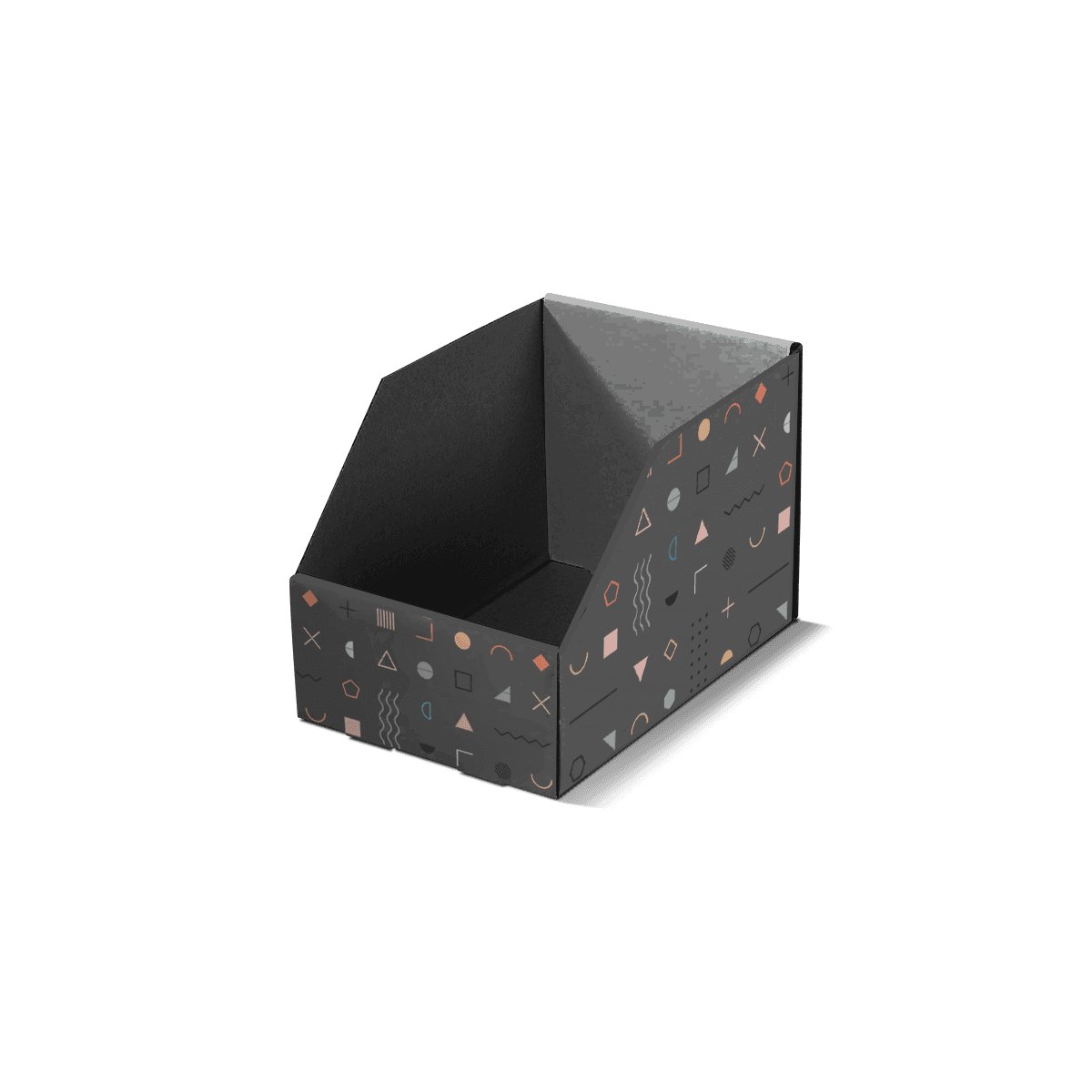
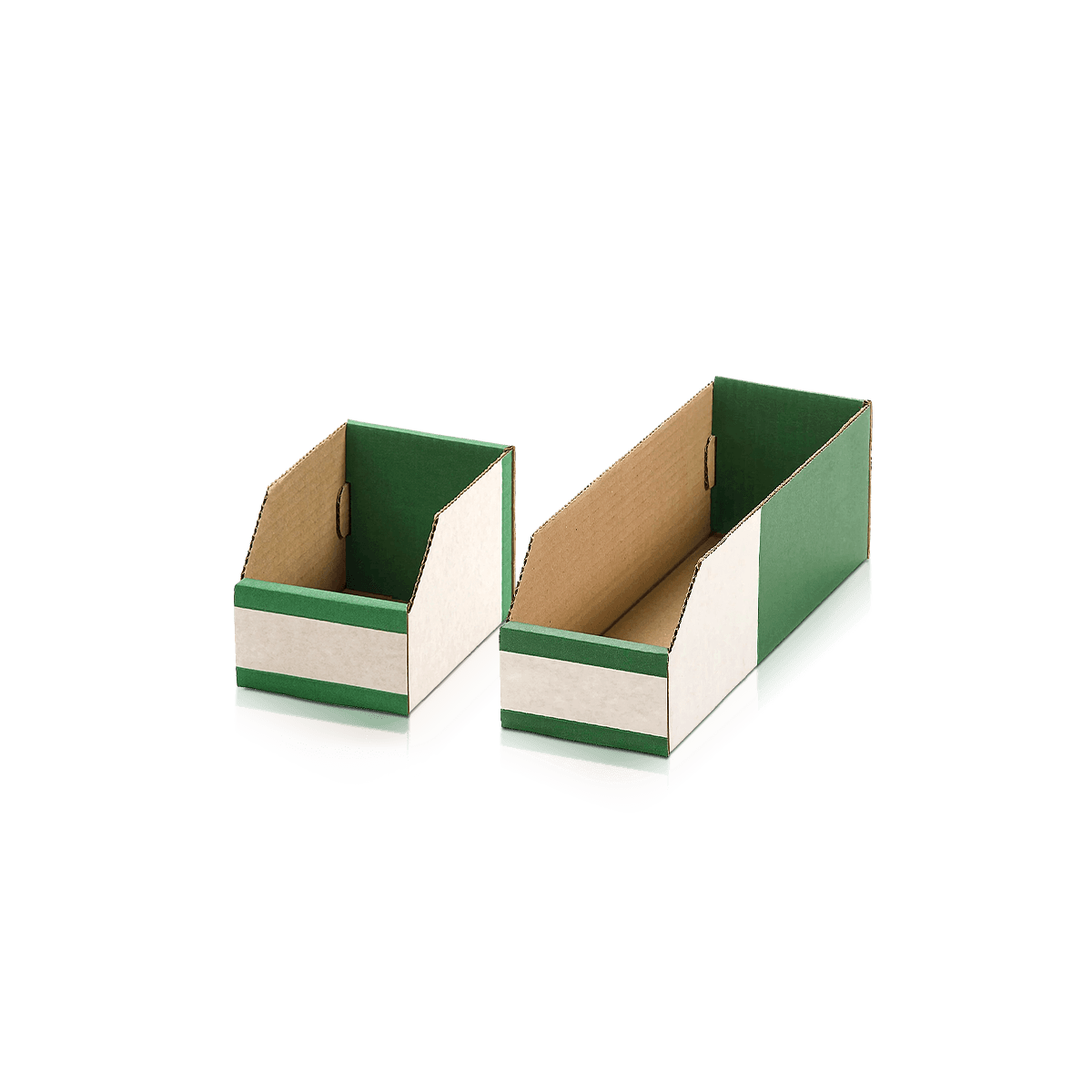
Open-front corrugated bins sized around shelf bays, pick frequency and part quantity so MRO stock stays visible and reachable at the point of use.

A Bin Is a Pick Point

Open-front picking turns a shelf position into a working inventory point. Custom Bin Boxes keep that point visible and reachable so workers can identify and remove small parts without lifting a lid or pulling an enclosed carton out every time.

That working geometry is different from ordinary storage packaging.

A warehouse bin has to hold inventory toward the back while leaving enough of the contents visible and reachable at the front. Its side walls need to resist spreading. The front lip must retain the stock without blocking the hand. The label has to remain visible after neighboring bins are installed.

In MRO packaging, a bin earns its space by shortening the path between recognizing a SKU and physically picking it.

Typical contents can include fittings, clips, packaged fasteners, bearings, electrical components, replacement hardware and recurring shop supplies. The exact item matters less than the access pattern: stock remains in one assigned position while pieces are repeatedly removed.

That is the role this structure should solve.
Design the Shelf Row

The shelf bay is part of the packaging specification because bin width determines how many SKUs can occupy the row.

Start with the actual usable shelf dimensions, not the nominal rack dimensions. Uprights, braces, lips and dividers can reduce the space the boxes can really occupy.

Face Width

A narrower face can increase SKU density, but there is a practical limit.

If the opening becomes too narrow for the worker's hand or for the part being picked, the extra shelf efficiency creates slower access. Long components can also become awkward when the bin is deep but the front opening is very narrow.

The front width therefore has to serve three things at once:

  • the part
  • the hand
  • the identification panel

A warehouse carrying many tiny fastener SKUs may favor narrow bins. Larger couplings, fittings or packaged repair components need more working width.

Shelf Depth

Using most of the shelf depth can increase capacity, but deeper is not automatically better.

If parts settle at the rear and cannot be reached without pulling the entire bin forward, the structure has lost much of its open-front advantage.

Deep bins make more sense for higher-volume stock that workers can still reach comfortably. Slow-moving small components may need less depth even when the rack could accommodate more.

Headroom

Vertical clearance above the front opening affects the pick motion.

A bin squeezed tightly beneath the shelf above may technically fit while leaving too little space for a hand to enter. The usable opening should be judged with the box already installed in its real shelf position.

The Front Lip Sets Behavior

The front lip is one of the most important dimensions on a corrugated bin box.

Too low and loose parts can migrate out. Too high and the worker has to reach over a wall every time something is picked.

The right height depends on the contents and how inventory behaves as the quantity falls.

A bin holding individually bagged bearings can tolerate more exposure than one filled with loose clips. A box containing long packaged parts may need enough lip height to stop the front ends from creeping outward.

Angled or cut-down side profiles can improve hand access while retaining more board toward the rear.

The front panel also has to leave enough area for identification. Reducing it until almost nothing remains may improve access but force the SKU label onto a side panel that disappears once several bins are placed together.

The opening, retention edge and label face should be designed as one feature.

Shelf Bins and Stackable Bins

Not every open-front bin should carry another loaded bin directly on top of it.

Some corrugated bin boxes sit on fixed shelving, so the rack carries the vertical load. Others are intended to form freestanding stacks and need a structure that transfers weight around the open face.

That difference should be explicit before the dieline is approved.

A shelf-supported bin can prioritize access because it does not have to act as a structural column.

A stackable corrugated bin needs stronger load paths and enough remaining front and side structure to resist deformation. The loaded weight, number of bins in the stack and how often the stack is disturbed all matter.

Dense components that push ordinary corrugated beyond a sensible working load belong closer to Heavy Duty Boxes or a reusable industrial container rather than an increasingly overbuilt open-front bin.

Do not use the word stackable as a styling feature. It is a structural requirement.

Pick the Last Piece

The final few pieces in a bin are a better design test than the first full load.

When a bin is full, stock naturally sits toward the opening. As it empties, the remaining pieces may settle against the rear wall.

A worker should not need to unload the bin, shake it or remove it from the rack just to retrieve the last fitting.

Several variables affect that reach:

Bin Length

Long bins increase capacity but increase hand travel.

The practical maximum depth depends on shelf height, front width and the size of the component.

Part Shape

Flat packaged items can slide against one another and remain reasonably accessible. Small round parts may scatter across the floor of the bin.

Very small loose items sometimes work better in a shorter bin with more frequent replenishment.

Working Height

A deep bin positioned at waist height behaves differently from the same bin near the top of a rack.

Operators may be able to reach downward into a low or mid-level bin but struggle to see stock remaining at the back of an elevated one.

Bin depth should therefore be checked against its intended shelf level, not only against part quantity.

Storage Is a Different Job

Open bins trade enclosure for access.

That makes them excellent pick locations but a poorer choice for stock that should remain closed, stacked and relatively untouched.

Closed Cardboard Storage Boxes fit reserve inventory that moves by carton rather than by individual piece.

Parts Storage Boxes suit stock systems where shelf capacity, containment and replenishment matter but permanent open-front access is not the defining requirement.

A practical warehouse can use all three formats.

For example, reserve cartons can hold unopened stock on a higher rack. Parts Storage Boxes can handle slower-access inventory. Bin Boxes can occupy the working pick face for the SKUs used most often.

The mistake is forcing every stock state into one box structure.

Corrugated Must Hold Shape

Corrugated board is often a practical material for disposable or semi-reusable industrial bins because it arrives flat, stays lightweight and can be printed directly.

Its job in a bin is slightly unusual.

A shipping carton relies on closure and four full walls to form a strong rectangular shell. A bin deliberately removes much of the front wall to create access.

That makes side-wall stiffness, rear-wall support and fold accuracy important.

The differences among corrugated, paperboard, kraft and rigid board matter when the contents move from lightweight consumables to denser industrial components.

Paperboard can suit very light small-format organization, but corrugated is generally the more practical direction when the bin needs deeper walls, greater stiffness or heavier contents.

Kraft can suit straightforward stockroom identification. White surfaces can improve contrast when printed SKU codes, colored identifiers or handling marks need stronger visibility.

Board should be selected around the loaded bin rather than around appearance alone.

Dividers Can Hurt Access

A divider is valuable only if it preserves the reason the bin exists.

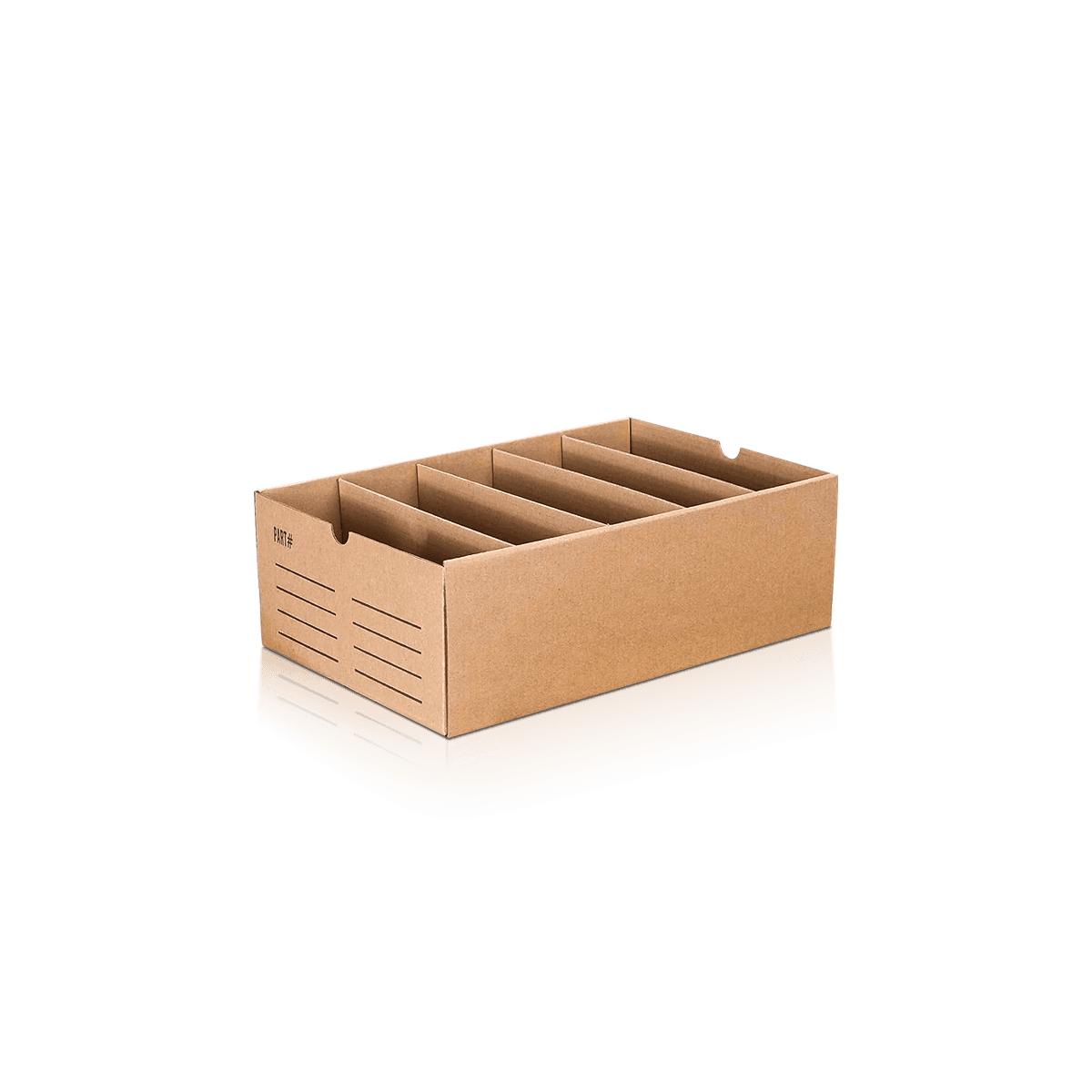
Several SKUs can sometimes share one footprint, especially when quantities are low. But dividing a narrow bin into several small cells can create compartments that are difficult to reach through the same open front.

Use Divider Boxes when separation between components deserves its own planned compartment system.

Inside a Bin Box, simple longitudinal separation may make sense for two compatible stocks. Complex grids often work better in a structure designed around the divider from the beginning.

There is also an inventory-control issue.

If several unrelated part numbers share one front opening, the identification system must make it obvious which compartment belongs to which code. A worker should not have to infer the contents from position alone.

When picking accuracy matters more than conserving a few inches of shelf width, separate bins are often cleaner.

Labels Belong at Eye Level

The bin face is operational real estate.

The visible front should make the SKU recognizable before someone reaches into the carton.

Depending on the stock system, print can carry:

  • item number
  • plain-language name
  • barcode or QR code
  • storage location
  • minimum quantity
  • issue unit
  • equipment association
  • department
  • color-coded stock group

Large identifiers deserve priority over decorative artwork.

A worker looking down a long row of identical corrugated bins needs contrast and consistency. Put the same type of identifier in the same position across the system.

Color can support recognition, but do not make color the only identifier. Similar colors become harder to distinguish under industrial lighting and color conventions may change between departments or facilities.

The best printed bin works from several feet away and still gives enough precision when the worker stands directly in front of it.

Refill From the Pick Face

A bin can expose a replenishment problem before the facility experiences a stockout.

If the contents are visible, workers can often see low inventory without opening anything. Packaging can strengthen that signal by making the interior state easier to judge.

A printed minimum line or clearly defined reserve area can support an existing reorder method.

The carton should not determine the reorder point. Usage rate, supplier lead time and safety-stock policy belong to inventory planning.

Packaging can make the chosen point visible.

High-turn consumables may fit Operations Supply Boxes when stock is issued in controlled refill quantities rather than continually topped up in one bin.

That creates an important decision:

Do you replenish the same bin, or replace an empty pack with a full one?

Continuous refill favors a durable assigned bin.

Pack replacement favors a defined issue box.

The workflow should decide which model wins.

Flat Supply Changes Labor

Corrugated Bin Boxes can ship and store flat before assembly, which reduces the space needed for empty packaging.

For a large warehouse rollout, that can be a major advantage. Hundreds of erected empty bins consume far more volume than the same structures supplied flat.

The trade-off is labor at installation and replacement.

A one-piece self-locking structure can often be erected without tape, but the number of folds and tabs still matters when a facility has hundreds of locations to build.

Assembly should be intuitive enough that workers do not create different versions of the same bin by folding tabs incorrectly.

Repeated assembly and loaded handling deserve custom packaging testing when a new structure will be deployed across many positions.

A well-designed bin should become square quickly, stay square after loading and remain easy to replace when worn.

Permanent Bins Have Their Place

Corrugated is not the automatic answer for every warehouse pick location.

Plastic or metal bins may be more appropriate when the same container must survive years of daily use, oil exposure, wet cleaning, outdoor conditions or heavy repeated impacts.

Corrugated becomes attractive when:

  • custom sizing materially improves shelf use
  • printed identification needs to be integrated
  • empty bins need to store flat
  • the deployment may change
  • replacement cost matters
  • the contents do not require a washable permanent container

This distinction is especially important during new warehouse setups.

Choosing paper only because the initial unit cost looks attractive can be false economy if every bin sits in a hostile environment. Choosing permanent plastic for every low-use dry shelf can also add unnecessary cost and take up more storage space before deployment.

The environment should settle that question before print or branding enters the discussion.

Standardize the Bay

Custom bins become easier to manage when the size system follows the rack system.

A facility with hundreds of SKUs usually benefits from a controlled set of bin widths and depths rather than a unique box for every component.

Suppose one shelf bay can accept twelve narrow bins, six medium bins or four large bins. Those modular widths create predictable combinations while still allowing different parts to receive appropriate capacity.

Height can also be standardized where shelf spacing permits.

This creates several operational benefits:

  • easier packaging inventory
  • simpler shelf planning
  • predictable label positions
  • faster replacement
  • cleaner expansion into new bays

Standardization should stop where access deteriorates.

An awkwardly oversized bin is not a good standard simply because it reduces the number of packaging SKUs.

A facility can spot packaging that is not ready to scale when box variants multiply faster than staff can control their assembly, labels and stock positions.

Retail Bins Are Different

Open-front warehouse bins and retail dump displays may look superficially similar, but their objectives are different.

The MRO bin is optimized for worker picking, part identification and efficient use of controlled shelf space.

Retail Bin Display Boxes put product visibility and shopper access at the center of the structure.

A retail display may need more printed surface, greater visual presence and a footprint that attracts attention. An industrial bin normally benefits from compact geometry and dense operational identification.

Do not turn warehouse storage into a merchandising structure simply because both formats use an open top or open front.

The environment decides what the open area is meant to accomplish.

Turn a Bay Into Specs

Custom Packly's USA MOQ starts from 100 boxes. Free design and dieline support can translate a shelf plan into a repeatable corrugated bin structure, and free 3D mockups can help check the front opening and printed identification before production.

US production and free shipping support domestic programs. Standard turnaround is 4–6 days after specifications and artwork are approved. Complex constructions or specialty requirements can need additional time.

For a new Bin Box program, record:

  • usable shelf width
  • usable shelf depth
  • vertical clearance
  • part dimensions
  • quantity held in each bin
  • loaded weight
  • number of SKU positions
  • preferred number of bin widths
  • front label fields
  • shelf-supported or freestanding use
  • expected pick frequency
  • expected quantity of each bin size

A fully custom physical sample can be arranged as a paid sample when the actual shelf fit, loaded shape or front access cannot be judged confidently from dimensions alone. Free sample examples of previous Custom Packly work may also be supplied.

Use those inputs to price the actual bay plan and bin mix rather than a generic open-front carton.

The Whole Row Must Work

A Bin Box should not be judged as an isolated carton.

Place ten or twenty of them side by side and the real design appears.

Can each label still be read? Do front lips line up cleanly? Can a hand enter the narrowest opening? Are deep bins reachable at every shelf level? Can one damaged box be removed without disturbing the row? Do the selected widths use the bay efficiently?

That row-level test is where small dimensional decisions become operational.

A fraction of an inch added to one bin may seem insignificant until twelve units no longer fit across a shelf. A deeper structure may look efficient until the last stock becomes unreachable. A larger label panel may help identification but make the pick opening too shallow.

Custom Bin Boxes work best when the complete shelf bay behaves like one organized picking system, with each carton doing its part.

FAQs

Bin Boxes are commonly used for bolts, fasteners, fittings, spare parts, connectors, adapters, samples, and other small items that need open access and organized shelf storage.

Bin Boxes work better when fast front access and easy shelf picking matter most, while Divider Boxes are a stronger choice when you need more internal separation inside a closed pack or shipper. The better format depends on whether your priority is daily retrieval or tighter compartmental storage.

Yes, when the board grade is selected for the item weight. Corrugated Bin Boxes can be engineered for light consumables or heavier parts depending on load, stacking needs, and handling frequency.

Most buyers use the front panel for SKU labels, barcode stickers, bin locations, reorder codes, or simple handwritten identifiers so teams can spot the right contents at a glance.

Most corrugated Bin Boxes ship flat to save space and assemble quickly at the point of use. That makes them practical for bulk orders, multi-site inventory programs, and changing shelf layouts.

Process

How it works

Your Packaging Journey, From Idea to Production and Delivery

01

Tell Us Your Specs

Custom packaging boxes

Tell Us Your Specs

Provide size, quantity, printing, and finishes.

02

Get a Fast Quote

Custom packaging boxes

Get a Fast Quote

Instant transparent pricing, no hidden fees.

03

Design and Approval

Custom packaging boxes

Design and Approval

Artwork checks, revisions, and final sign-off.

04

Produce

Custom packaging boxes

Produce

Expert manufacturing to meet deadlines.

05

Ship to Your Door

Custom packaging boxes

Ship to Your Door

Hassle-free, flexible delivery options.

Get Your Quote for Custom Bin Boxes

Share your product details, size, quantity and artwork needs. We’ll help choose the right packaging style and send a clear quote.