Packaging Styles
Compare packaging structures by product fit, transit duty, retail use, pack-out and opening behavior, then narrow the format before choosing materials, print or finishes.
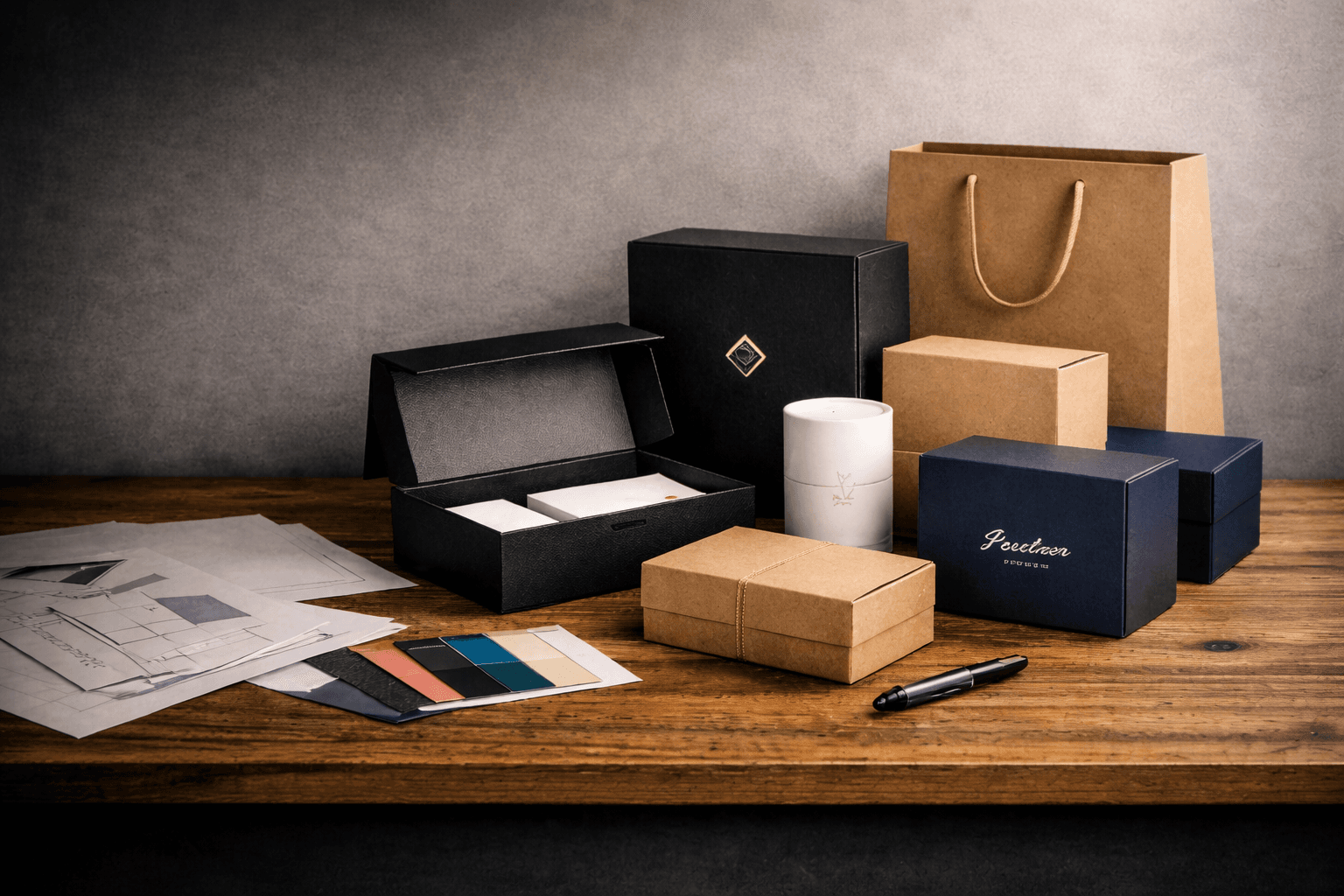
Compare Structures by Physical Duty
The fastest way to compare packaging styles is to look at what physically changes when you switch formats: wall construction, closure, loading direction, storage footprint, transit duty and the way the customer reaches the product. Those differences rule out weak options faster than choosing by appearance.
Use the physical differences between formats to narrow the structural direction first. The useful question is whether the package must mainly protect, present, merchandise, carry, serve, contain or ship.
Transit duty changes the outer structure
If the package will travel through a parcel or warehouse network, start with load and handling. Shipping boxes put compression, stacking and sealing first. Custom mailer boxes can combine corrugated protection with a cleaner branded opening when the product and packed weight suit the format.
A customer-facing pack does not automatically need to perform as the shipper. Treating every attractive carton as transit packaging is one of the easiest ways to create crushed panels, excess filler or an oversized outer box later.
Presentation changes stiffness and opening
Folding cartons are useful when a lightweight product needs efficient flat storage, clear retail panels and a printed secondary pack. Custom rigid boxes make more sense when wall stiffness, insert depth, a substantial opening action or long-term presentation matters enough to justify a heavier formed construction.
Neither format is automatically more correct. The better choice depends on whether the packaging is expected to disappear after purchase or remain part of the product experience.
Pack-out changes what is practical
A structure can fit perfectly and still be wrong for a packing line. Flat supply, erection steps, locking tabs, taping, insert placement and closure pressure affect how quickly employees can pack repeat orders. Storage also matters: a formed rigid box consumes warehouse volume in a way a flat folding carton does not.
Shape and Access Rule Out Formats
Some products stop being a normal rectangular-box problem once shape, access or the handoff method becomes dominant. That is where less box-like formats earn their place.
Round and tall products change measurement logic
Custom tube packaging is useful when diameter, usable internal length and end closure matter more than a standard length × width × height carton. Rolled goods, bottles, tall gifts and cylindrical products can be easier to contain in a tube than in an oversized rectangular box.
Carry, serving and flexible containment differ
Custom paper bags solve handoff and carrying rather than rigid enclosure. Custom cone sleeves are built around grip, serving and an exposed cone profile. Flexible pouches become relevant when compact storage, seals, resealability or barrier-style construction is more important than rigid walls.
These formats should not be treated as decorative alternatives to a box. They change the filling method, closure, usable print area, storage behavior and often the way the customer handles the product.
Merchandising can become the structure
Display boxes are selected around visibility, facing count, access and replenishment. A counter display, peg format or floor display is doing a store job that a conventional product carton does not solve by itself.
Retail and Ecommerce May Need Two Layers
One package can serve retail and ecommerce only when it handles both jobs without becoming inefficient. A durable, compact product may use one main pack across channels. A fragile bottle, premium rigid set or shelf-focused carton may work better as the product-facing layer inside a separate corrugated shipper.
Retail places more pressure on panel communication, shelf footprint and merchandising. Ecommerce adds parcel handling, empty-space control, closure security and packing speed. Wholesale can add case packing and repeated warehouse handling. The structure should follow the route that actually creates risk.
When the same SKU sells through both channels, retail packaging versus ecommerce packaging shows how one shared pack, a primary pack plus shipper or separate formats change the operating system. If the uncertainty is specifically between cartons and corrugated formats, compare the roles of mailers, shippers and folding cartons before asking one box to do all three jobs.
A second packaging layer is justified when it solves a different problem. It is waste when it exists only because the first structure was chosen without considering the route to the customer.
Closure Changes Labor and Reuse
Once the structural direction is clear, closure and assembly often become the next useful filter. Two boxes made from similar paperboard can behave very differently if one is a simple tuck carton and the other uses a lock-bottom, sleeve, drawer or gable construction.
When the decision is specifically about how a made-to-order box folds, locks, slides, carries or opens, Custom Packaging Types narrows the choice to exact box constructions. First settle whether a paperboard box is the right broad direction at all.
Use closure to solve a real operating need. Faster erection can matter in repeated manual packing. A reusable opening may matter for a product kept in its box. A sleeve can separate visual reveal from the inner tray. A lock-bottom can make sense when base setup and load handling justify the extra structure.
Do not add structural complexity because it looks more custom in a rendering. Every flap, lock, insert and moving part has to earn its place in assembly, protection, presentation or reuse.
Material Confirms the Structure
Material should confirm the structural choice, not rescue the wrong one. Paperboard suits scored folding cartons because it prints and folds cleanly. Corrugated board adds fluted construction where mailers, shippers and some displays need more edge or compression strength. Rigid board supports wrapped presentation boxes with thicker walls. Flexible laminates belong to pouch systems where seals and barrier behavior are part of the format.
The useful material question is specific: what must the package resist or enable? That may be bending, stacking, puncture, moisture exposure, repeated opening, detailed print or a premium wrapped surface.
Printing and finishes should be resolved after those physical requirements are clear. Panel size, folds, seams, gussets, tube curvature and closure areas all change where artwork can sit. When board, print method, finish or insert construction becomes the main decision, packaging capabilities provides the production-level detail.
Use Industry When Product Context Leads
Start with structural formats when you already know the type of package you want to compare. Industries becomes more useful when the product type creates the difficult part of the brief.
A cosmetics project may be controlled by pump height, cap clearance and small-panel information. Food service can be controlled by loading speed, grease or moisture exposure and handoff. Ecommerce can be controlled by parcel handling and dimensional efficiency. MRO products can be controlled by concentrated weight, parts separation and repeated identification.
Those pressures can point to very different structures inside the same industry. Industry context identifies the operating problem; structural selection identifies the physical format that can solve it. Neither should duplicate the other.
Bring a Shortlist to Specification
You do not need a finished dieline before asking for structural help. A useful shortlist starts with the facts that can eliminate bad options: finished product dimensions and weight, number of items per pack, fragile or pressure-sensitive areas, preferred orientation, sales channel, whether the pack ships by itself, expected quantity, storage limits and the opening experience you want.
Custom Packly has 15 years in business and works with US production partners. Free design and dieline support plus free 3D mockups can help turn those inputs into a structure that can actually be reviewed before production. Free sample examples of previous work are available where relevant; a fully custom pre-production sample can be arranged as a paid sample when an exact structure, print or finish needs physical validation.
The USA MOQ starts from 100 boxes. Standard turnaround is 4–6 business days after final artwork and specifications are approved; complex structures, specialty materials and advanced finishes may require additional time.
A good shortlist should have reasons attached to it. You should be able to say why a format suits the product, what risk it solves, what it asks from the packing operation and what would make you reject it. At that point, pricing and production choices become comparisons between workable structures instead of guesses between box names.
FAQs
Start Your Custom Packaging Quote
Share your product details, size, quantity and artwork needs. We’ll help choose the right packaging style and send a clear quote.