An 18 × 12 × 12-inch box may be easy to order, but availability does not make it the right size for your shipment. A box can hold the product and still waste space, increase freight charges, or leave an item free to strike its walls.
Standard shipping box sizes in the US are commonly stocked dimensions, usually stated in inches as length × width × height (L × W × H). There is no single official list that every box supplier follows. Use common sizes to narrow the choices, then measure the packed product and check the finished outside dimensions before buying.
For businesses ordering custom packaging, our preference is to choose the protective arrangement first and the box dimensions second. Picking a familiar box size and filling whatever space remains often reverses the decision that matters most.
What Counts as a Standard Shipping Box Size in the US?
A standard size is a stock dimension frequently offered by corrugated box suppliers. It is not a universal manufacturing specification or a USPS, UPS, or FedEx requirement. One distributor might stock 12 × 9 × 6 inches, while another prioritizes 12 × 10 × 8 inches. Board grade, flap construction, and actual internal measurements can also differ.
Most corrugated box listings describe inside dimensions: the space available for contents. Shipping carriers assess the outside dimensions of the sealed parcel. That difference can affect your shipping estimate even when a carton looks like a simple 12-inch cube.
The size examples below are common formats, not guarantees of availability or product compatibility. Each use is a starting point, and fragile or unusually shaped products may need a different footprint.
Standard Shipping Box Sizes in Inches: Quick Reference
Small Shipping Boxes
Small boxes can be inexpensive to fill and quick to handle, but a fragile item can consume most of the usable space once properly cushioned. Do not choose 6 × 6 × 6 merely because the product is five inches across.
Medium Shipping Boxes for Everyday Orders
This is where shape starts to matter more than a simple small, medium, or large label. A 16 × 12 × 8 box has considerably less internal volume than a 16 × 16 × 16 cube, despite sharing the same longest dimension.

Large Shipping Boxes and Bulk Packs
Large is not the same as heavy duty. Weight distribution, corrugated strength, stacking conditions, and closure design still determine whether the carton is suitable. A light but bulky parcel may need a different approach from a dense 20-pound machine part.
Across these sizes, shipping boxes are best assessed as a packed case, not an empty container.
Common Mailer Box Dimensions
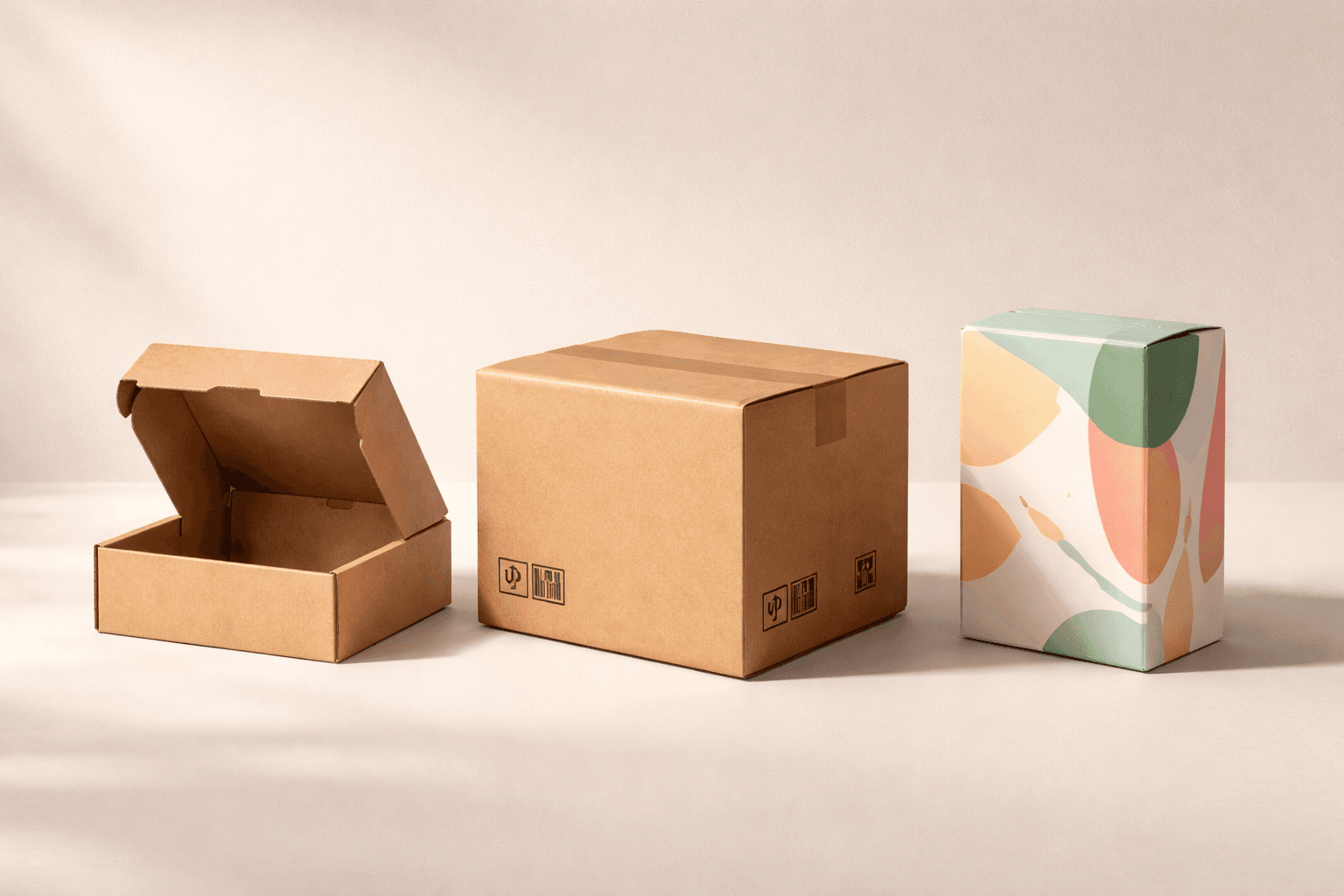
Mailer boxes usually have a die-cut, self-locking or tuck-style opening rather than a conventional taped top and bottom. Common footprints include:
These are indicative dimensions; opening flaps, double-wall edges, and the specific die-cut design can reduce usable clearance. A 12 × 9 × 4 mailer is not necessarily interchangeable with a regular shipping carton labeled 12 × 9 × 4. For products where presentation and parcel delivery share the job, mailer boxes may be a more suitable structure.

Inside vs Outside Box Dimensions: The Difference That Changes Shipping Cost
Packaging suppliers generally size a corrugated box from its usable interior. Carriers measure the completed parcel from its most extreme outside points, including any bulge or distorted panel.
If a box is described as 12 × 12 × 12 inches internally, its external dimensions must be larger because the board has thickness. Depending on the flute and construction, those extra fractions can push the carrier's rounded measurement to the next inch.
For example, suppose a sealed parcel measures 12.2 × 12.2 × 12.2 inches externally. Under a carrier rule that rounds each measurement up, the chargeable dimensions become 13 × 13 × 13 inches, or 2,197 cubic inches. Treating the nominal 12-inch interior as the shipping measurement would understate its billable volume.
A practical purchasing specification should therefore record two numbers:
Never copy an inside-size listing directly into your shipping software without checking the completed package.

How to Choose the Right Box Size for Your Product
Start With the Product in Its Shipping Condition
Measure the item exactly as it will travel. Include its retail carton, protective sleeve, bottle cap, attached handle, power cord, bundled accessories, or any other part that changes its shape.
For an assortment, arrange the pieces in their intended shipping positions before measuring. The best orientation is often a shallow, stable layer rather than a tall pile that forces a larger box.
Allow Only the Clearance Your Protection Needs
There is no universally safe extra inch to add to every side. A ceramic mug, a boxed shirt, and a metal replacement part need very different protection.
Set clearance after choosing the protective method: corrugated dividers, a fitted tray, foam, paper cushioning, or another tested arrangement. The product must not move freely, but cushioning also needs enough space to work instead of being crushed flat.
An illustrative example: a retail kit measures 10 × 7 × 3 inches. A 12 × 9 × 4-inch box may look close on paper, but if the kit requires half an inch of protection above and below, that four-inch internal height is already fully occupied. The actual insert and packed fit decide whether the configuration works.

Check Closure, Packing Direction, and Repeat Handling
A carton that technically fits may be awkward to load. Ask whether employees can place products without forcing the walls outward, whether the top closes flat, and whether the same fit holds across production tolerances.
For straightforward warehouse cases, regular slotted containers are a sensible baseline because they store flat and work with conventional taping. Special openings should solve a real packing or customer-use requirement.
Compare the Finished Parcel With Carrier Rules
Measure an assembled, filled, closed sample. Obtain the packed weight, rounded carrier dimensions, and rate quotes for the services you actually use. Repeating this exercise for two or three candidate sizes is more reliable than assuming the smallest-looking carton is automatically cheapest.
When the dimensions need to be transferred into artwork or construction drawings, a dieline generator can help visualize the layout. The dieline is a design starting point; it does not replace assembled-box measurement or physical fit checks.
How Box Dimensions Affect USPS, UPS, and FedEx Rates in 2026
A lightweight parcel can cost more than expected because it occupies substantial space on a truck or aircraft. Carriers may calculate dimensional weight (DIM weight) using the outside length, width, and height:
DIM weight (lb) = length × width × height (inches) ÷ applicable divisor
The calculated weight is typically rounded upward under the relevant service's rules and compared with the actual weight. Service prices, thresholds, discounts, and surcharges still depend on the carrier and the shipment.
USPS: The July 2026 Change Matters
Effective July 12, 2026, USPS changed the DIM divisor from 166 to 139 for covered services such as Priority Mail, Priority Mail Express, USPS Ground Advantage, and Parcel Select. For rectangular parcels, USPS applies this DIM calculation when the rounded cubic volume exceeds 1,728 cubic inches (one cubic foot). Dimensions with fractional inches are rounded up before calculating volume.
That means a parcel measuring exactly 12 × 12 × 12 inches externally is at 1,728 cubic inches, while one that rounds to 13 × 12 × 12 inches reaches 1,872 cubic inches and crosses the threshold. This is another reason a nominal 12-inch inside cube should not be treated as a one-cubic-foot shipping parcel.
Check the current USPS mailing standards rather than older calculators that still show a 166 divisor.
UPS and FedEx: Check the Actual Rate Type
UPS lists a DIM divisor of 139 for Daily Rates and 166 for Retail Rates on its US shipping-dimensions page. FedEx uses dimensional-weight billing for applicable FedEx Express and Ground packages; its public US calculator lets you estimate the outcome from actual dimensions. Account agreements and service rules can affect the final rating.
Always consult UPS package measurement rules and the FedEx DIM calculator for the service and rate type involved.
Worked Example: A Few Inches Can Change Billable Weight
Consider two hypothetical parcels measured on the outside, each containing the same 4-pound kit:
For a service that uses this divisor and bills the greater of actual or DIM weight, the rating basis falls from 19 pounds to 12 pounds, seven billable pounds less. This is not a promised dollar saving; the final charge depends on the carrier, zone, service, contract, and surcharges.
There is an important USPS distinction: under its current rectangular-parcel threshold, the smaller 1,536-cubic-inch parcel would not trigger this particular DIM calculation, while the larger parcel would.

Two Packaging Scenarios Worth Learning From
Illustrative Case 1: The Subscription Kit With Too Much Air
Imagine a wellness company shipping a four-piece kit in an 18 × 14 × 10-inch outside parcel. The kit sits low in the box, with loose fill taking up the sides and top. The company assumes it needs a stronger box because products sometimes arrive shifted.
The better question is whether the kit should sit in a fitted tray inside a lower carton. A redesigned protective arrangement might permit the 16 × 12 × 8-inch outside parcel used in the calculation above. The savings opportunity comes from changing the packed geometry, not simply squeezing the same loose fill into less space.
The downsized configuration would still need fit and handling checks. If it works, it can reduce billed volume and the amount of void fill per order. If it transfers impacts directly into fragile components, the smaller box is a bad trade.
The same volume problem becomes harder to ignore as daily order counts rise. Packing labor, damage, and SKU proliferation all play into packaging decisions as a business scales.
Illustrative Case 2: One Stock Box for Three Very Different Orders
A small apparel seller carries flat T-shirts, boxed accessories, and occasional multi-item bundles. Using one 16 × 12 × 8-inch stock carton for every order simplifies purchasing, but small orders need extra filler and some ship as mostly empty air.
Buying a different custom carton for every possible combination would create its own inventory problem. A better trial might use a shallow mailer for single-item orders and retain the existing carton for bulkier bundles. The company should review actual order frequency before deciding whether two sizes are enough.
Where the length and width remain consistent but packed height changes, multi-depth boxes may also reduce the number of separate carton SKUs. They are helpful only when the score positions, closure, and packing instructions are practical for staff.
These are hypothetical decision examples, not measured Custom Packly customer results.

When a Standard Box Is the Wrong Choice
A readily available stock size is often the simplest and least expensive choice for a low-volume operation. Custom sizing becomes more compelling when the same wasted clearance, packing complication, or protection problem repeats across many shipments.
Pay attention to five triggers:
For a product with unusual dimensions, custom corrugated shipping boxes can be built around the measured pack rather than forcing the product into the nearest stock cube.
Custom is not automatically cheaper. Compare box purchase cost, minimum order, storage, assembly time, filler, potential damage, and actual carrier quotations. A low-volume seller might rationally accept some empty space to avoid holding multiple specialty sizes.
A Box Size Does Not Tell You How Strong the Box Is
Two cartons can share the same interior dimensions and behave very differently in transit. Corrugated construction, wall count, board grade, flute choice, panel span, and how the contents support the case all matter.
A 20 × 14 × 10-inch carton filled with lightweight textiles and a carton of the same size holding dense metal parts should not receive the same specification by default. The dense load may stress the bottom closure or concentrate force on corners. A bulky, lighter item can create large unsupported panel spans.
A stronger case is warranted when the packed load and route support that choice, not merely because the box is labeled large. For demanding freight and heavier case loads, heavy-duty shipping boxes offer a more appropriate starting point than assuming an ordinary single-wall stock carton is sufficient.
The last check should be conducted on the packed package, not an empty box sample. Drop exposure, vibration, stacking, closure integrity, and product movement require different checks. Match them to the shipment's risk, as you would when testing custom packaging for transit and production.

Shipping Box or Mailer Box: Which Should You Use?
A standard taped shipping carton makes sense for warehouse replenishment, mixed case packs, heavier items, and operations built around regular slotted cases.
A mailer may be preferable for a lighter, relatively flat item when the parcel itself forms part of the delivery presentation. It can also reduce assembly steps in some operations, although a die-cut mailer is not automatically cheaper or stronger.

The sales channel affects the answer. A product designed primarily for retail display may need a printed inner carton inside a protective outer case; a direct-to-consumer order might use one carefully specified corrugated pack. The trade-offs differ when retail and ecommerce packaging have to serve the same product.
Frequently Asked Questions About Shipping Box Sizes
What Is the Most Common Shipping Box Size?
There is no single officially standardized size used by every US supplier. A 12 × 12 × 12-inch cube is widely recognizable, but flatter sizes such as 8 × 6 × 4 and 12 × 9 × 4 inches may suit individual ecommerce orders better.
Are Shipping Box Dimensions Listed in Inches or Centimeters?
US corrugated box suppliers usually list dimensions in inches as length × width × height. If a product specification arrives in millimeters, convert it before comparing stock sizes, and confirm whether the listed dimensions are internal.
Does a 12 × 12 × 12 Box Count as One Cubic Foot?
Its nominal inside volume is one cubic foot. Its finished outside volume is larger because the corrugated walls have thickness. For carrier calculations, measure the packed exterior and follow the relevant rounding rules.
How Much Room Should You Leave Around a Product?
Enough for the specific protective arrangement, but not so much that the contents move freely. There is no universal clearance for a framed print, glass bottle, garment, and electronic device. Use a fitted trial pack to confirm the answer.
Can One Shipping Box Size Work for Every Product?
Usually not without compromise. A limited set of carefully chosen sizes may cover most orders, but product shape, fragility, bundled quantity, and carrier charges determine whether one carton is practical.
Before You Order Your Shipping Boxes
Start with the finished product, settle the internal protection, and then use the sizes above to find two or three plausible options. Assemble them, record the outside dimensions and packed weight, compare carrier quotations, and keep the smallest configuration that still protects the contents reliably.
For US businesses preparing repeat orders, Custom Packly can help specify structure, dimensions, printing, and quantity, with a minimum order starting at 100 boxes, free design support, 3D mockups, US production, and free shipping. The objective is a carton that fits the shipment and the way your business packs it, not simply a box that happens to be in stock.