Retail Packaging vs Ecommerce Packaging: The Quick Answer
Retail packaging and ecommerce packaging should not automatically be the same.
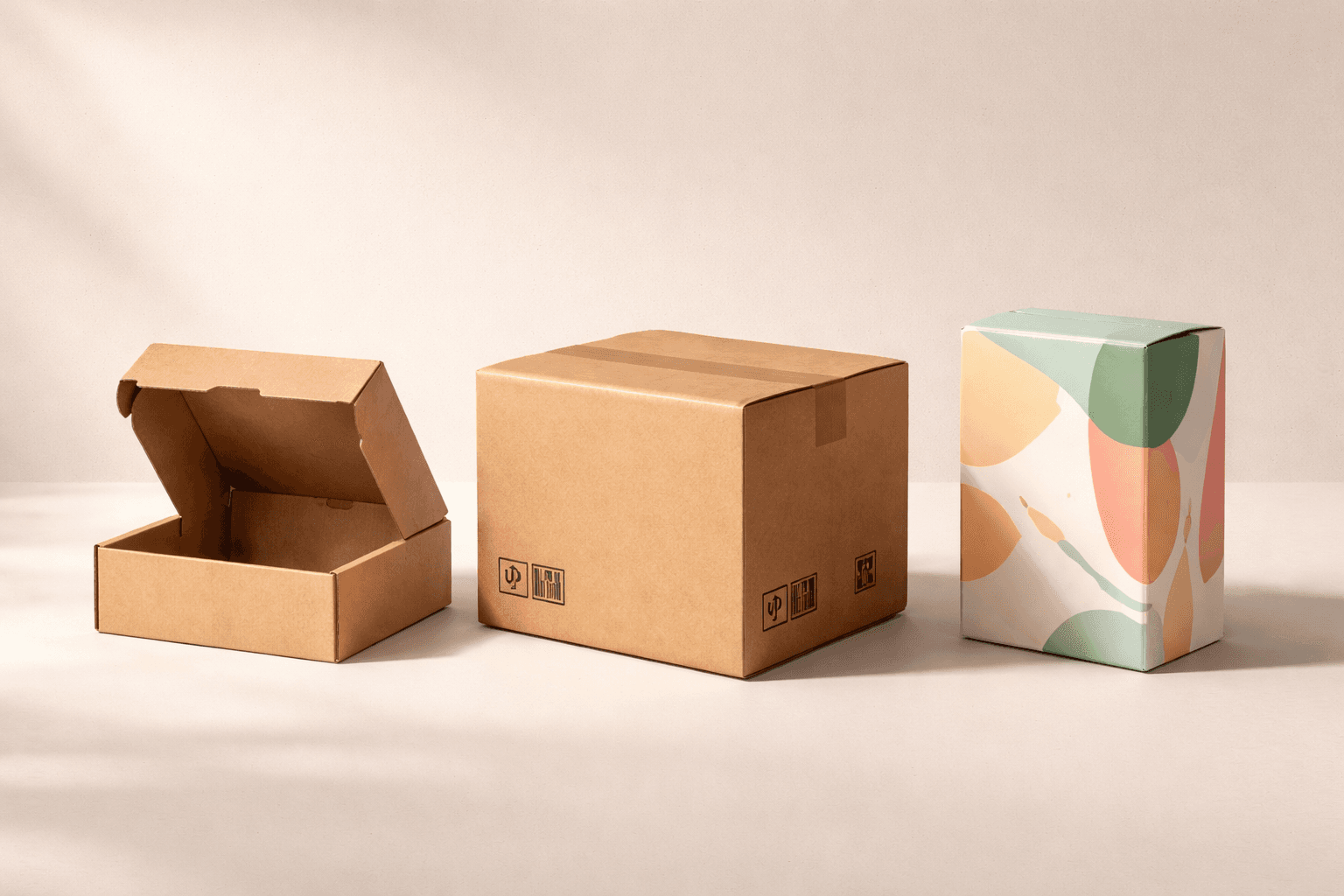
Retail packaging has to help a product get noticed, understood and picked up in a store. Ecommerce packaging has to protect that same product during parcel handling while controlling shipping cost and packing time.
In practice, I normally see three workable setups:
The mistake is deciding based only on the price of the empty box.
Packaging affects freight, parcel charges, storage, warehouse labor, damage, returns, inventory and customer experience. A box that costs $0.30 less can easily become the more expensive system once those costs are included.
At Custom Packly, we start with the product and sales channel before deciding what the package should look like.
Start With the Product
Before discussing foil, color, windows or unboxing, I want to know what the package actually has to protect.
Measure Fragility First
Glass bottles, ceramics, liquids, delicate electronics and products with vulnerable components need a very different structure from clothing, books or solid accessories.
For a fragile item, I look at questions such as:
A stronger outer box does not solve everything.
If the product can move freely inside it, that movement can still cause breakage, scuffing, bent components or damaged labels.
That is why good custom product packaging starts with product dimensions, weight, fragility and internal fit rather than forcing an item into a convenient stock size.
Measure the Product, Not the Current Box
I also want the exact product dimensions and weight.
If a brand tells me only the dimensions of its existing box, I still do not know whether the packaging is efficient.
A product measuring 5 × 3 × 2 inches may be sitting inside an 8 × 6 × 4-inch carton simply because that was the easiest stock size to source.
That excess space becomes much more important when thousands of parcels are shipped.
Consider Value to Volume
Packaging spend should also make sense relative to the product.
A small $200 device, watch or concentrated serum can justify more expensive protection because one damaged unit carries a meaningful replacement cost.
A large, low-value item gives you much less room for packaging and freight overhead.
The real question is not:
How cheap can we make the box?
It is:
What packaging cost gives us the lowest total cost of getting this product safely to the customer?
Let the Sales Mix Drive the Decision
Once the product risk is clear, I look at where the units are actually being sold.
A company doing 80% retail has a different packaging problem from one doing 80% DTC.
When Retail and Wholesale Dominate
If roughly 70% or more of sales are moving into stores or wholesale distribution, I usually let retail requirements drive the primary pack.
That may mean:
Well-designed custom retail packaging should make merchandising easier as well as making the product look good.
For many lightweight consumer products, folding cartons work especially well because they store flat, print sharply and provide plenty of space for branding and product information.
If ecommerce represents only a smaller share of orders, I would often keep that primary retail carton and add a fitted corrugated shipper for online orders.
When Ecommerce Dominates
If DTC and marketplace orders account for roughly 70% or more of volume, I start asking whether the retail package should still dictate the system.
Often, it should not.
For online fulfillment, I care more about:
Branded mailer boxes can give lighter DTC products a strong balance between presentation and transit protection.
Heavier products, multi-item orders and tougher distribution conditions may need shipping boxes instead.
The dominant channel should usually drive the core packaging economics.
When Sales Are Split Across Channels
A balanced channel mix requires more scrutiny.
This is where brands often force one box to do too many jobs simply because maintaining one packaging SKU feels easier.
One SKU is operationally simpler only if it performs both jobs efficiently.
If the supposedly simple solution creates:
then it is not really the simpler system.

Choose One of Three Packaging Setups
Once I know the product and channel mix, I decide which of three architectures makes sense.

Option 1: Use One Format Everywhere
A shared package works best for durable, compact products with low transit risk.
Apparel is a good example.
A shirt, scarf or soft textile can sit inside an attractive carton for retail and then move into a lightweight outer mailer for a DTC shipment without requiring heavy cushioning.
Other durable products may also work with one primary format when:
The advantage is straightforward: fewer packaging SKUs, simpler purchasing and easier inventory management.
Option 2: Keep the Primary Pack and Add a Shipper
This is often the best middle ground.
The retail carton stays because it still performs a valuable selling function.
For online orders, that carton goes into a fitted corrugated shipping box.
I like this setup when:
This allows the brand to keep one customer-facing pack while changing only the distribution layer.
Option 3: Split Retail and Ecommerce Packaging
Separate packaging becomes more attractive when the shared setup repeatedly creates costs elsewhere.
Warning signs include:
Around 1,500 or more online orders per month, I would normally run the numbers carefully.
I do not treat 1,500 orders as a universal cutoff. Product value, damage risk, packaging costs, storage and negotiated carrier rates can move the tipping point considerably.
It is simply a useful point at which separate ecommerce packaging can start paying for itself.
Do Not Judge Packaging by Unit Price
One of the most expensive mistakes I see is comparing packaging suppliers only on the unit price of the box.
That number says very little about the full operating cost.
DIM Weight Can Wipe Out Box Savings
Parcel carriers may bill based partly on package dimensions when a parcel occupies more space than its scale weight would suggest.
The exact calculation depends on the carrier, service and agreement.
What matters is the principle:
Shipping empty space costs money.
An oversized retail carton placed inside an even larger shipping carton can create a particularly bad result.
Now you are paying for:
This is why I would happily pay slightly more for a right-sized structure if it reduces a recurring parcel cost.
Void Fill Has Four Costs
Brands often look at bubble wrap or kraft paper as cheap consumables.
They have four separate costs:
Loose fill also does not always control movement consistently.
If product protection depends on a warehouse worker deciding how much paper to stuff into every box, performance will vary between orders.
A fitted insert creates repeatability.
For products already arriving damaged, the most useful starting point is identifying the actual failure mechanism. Our work on reducing shipping damage with better packaging structure and fit covers product movement, inserts, board strength and empty space in more detail.
Labor Becomes Expensive at Scale
A packaging process can feel perfectly reasonable when you assemble ten orders yourself.
Now repeat it 10,000 times.
Imagine one pack requires:
If that takes 60 seconds and a redesigned mailer takes 15 seconds, the difference is 45 seconds per order.
Across 10,000 orders, that is 125 labor hours.
This is why packaging that works at startup volume can fail as a company grows. We look at that problem more closely in Packaging That Scales: What Growing Brands Get Wrong.

A Cosmetics Brand That Needed Two Formats
A representative US cosmetics case shows why the decision cannot be based on appearance alone.
The company sold premium facial serums in glass bottles and clay-mask products.
It originally sold mainly in boutique stores.
The Retail Box Worked
The original carton was thin printed paperboard with:
For retail, it did its job.
The problem began when DTC sales grew quickly.
Instead of developing ecommerce packaging, the company kept the retail carton and tried to protect it with extra materials.
The Ecommerce Setup Failed
Warehouse staff wrapped each retail carton in bubble wrap and placed it inside an oversized brown shipping box.
More filler was added to stop movement.
Three problems appeared.
First, transit damage reached roughly 8%. Display windows punctured, paperboard corners crushed and glass bottles remained vulnerable.
Second, the larger parcel increased shipping costs because the company was sending far more volume than the product actually required.
Third, packing became slow. Employees were manually cutting and wrapping protective material for each shipment.
The retail package was still good.
It was simply being asked to do the wrong job.
We Changed the Ecommerce Structure
The retail carton stayed for store inventory.
Online orders moved to a compact E-flute corrugated mailer with a fitted corrugated insert.
The bottle sat directly inside the insert, which stopped it moving and kept it away from the outer walls.
The ecommerce box used a restrained exterior and placed more branding inside the lid.
That allowed the package to remain discreet during delivery while still creating a strong reveal when opened.
The Economics Changed
The representative results were substantial:

The important lesson is not that every cosmetics company needs separate packaging.
It is that an existing retail carton should not be protected from redesign merely because money has already been invested in it.
If the sales channel changes, the packaging economics change too.
Spend Where Failure Is Expensive
My strongest packaging-budget rule is simple:
Structure before decoration.
A crushed box still looks cheap after you add foil.
For Retail, Spend on the Outside
Retail packaging earns its money before the customer opens it.
I am more willing to spend on:
The point is not to stack finishes onto the box.
Every finish should have a job.
Well-planned custom printed boxes use print, color and finishing to support the sales environment instead of adding decoration for its own sake.
For Ecommerce, Spend on Structure and Fit
Online packaging earns its money after it leaves the warehouse.
I prioritize:
A plain-looking shipping box that arrives intact can provide a better brand experience than an expensive printed box that arrives crushed.
Put More of the Ecommerce Experience Inside
For many DTC brands, I prefer a restrained exterior.
Then I use the inside for:
The outside has to survive delivery.
The inside creates the reveal.
That distinction can save finishing cost without making the customer experience feel cheap.

Stop Using Loose Fill as a Structural Solution
Loose fill has a place, but I do not like using it to compensate for a poorly fitted box.
If a fragile product moves substantially inside the package, I would rather engineer its position.
A corrugated, paperboard or molded-pulp insert can:
An insert costs more upfront than a handful of kraft paper.
That does not mean it costs more operationally.
If it saves packing time and prevents even a small percentage of damaged orders, the economics can reverse quickly.

Be Careful With Rigid Boxes
Rigid boxes look substantial and can create an excellent premium presentation.
That does not make them the right answer for every premium product.
Traditional rigid setup boxes can consume much more warehouse space because many formats do not store flat.
That affects:
For truly high-value products, keepsake packaging and premium sets, those costs may be justified.
For many everyday retail products, a printed folding carton is more efficient.

For DTC, a well-designed corrugated mailer can create an excellent opening experience without the storage penalty of a traditional rigid box.
Use the structure because the product needs it, not because “premium” has become shorthand for rigid.
Amazon and Wholesale Need Separate Checks
A four-channel brand cannot assume that retail, DTC, Amazon and wholesale all impose the same operating conditions.
Amazon
Marketplace fulfillment can introduce packaging, labeling, testing and prep requirements that differ from orders leaving your own warehouse.
Before finalizing the structure, confirm the current Amazon requirements that apply to the product and fulfillment method.
The practical question is whether the product can move safely in the proposed package without unnecessary secondary packing.
Wholesale
Wholesale introduces another packaging layer: the master carton.
Now I care about:
A beautifully optimized consumer package can still create poor economics if the master cartons waste pallet space.
The retail pack sells the item.
The master carton moves inventory efficiently.
Both matter.
Use Sustainability to Remove Waste First
I prefer practical sustainability over expensive materials chosen mainly because they sound new.
The first opportunities are usually much simpler:
The broader custom packaging decision should consider material, structure, shipping efficiency and product protection together.
A smaller corrugated pack that prevents damage can make more sense than an exotic material that requires extra secondary packaging to survive delivery.
Do not reduce material so aggressively that products start breaking.
Replacing a damaged product uses far more resources than the few grams of packaging that could have prevented the failure.
Four Numbers Tell Me When Packaging Is Failing
When I assess an existing ecommerce setup, I pay particular attention to four operating signals.
Damage Rate
Once transit-related damage starts moving above roughly 1%, I want to know why.
That is a warning level, not a universal rule.
For a low-cost product, the economics may tolerate more.
For a high-value glass bottle, even 1% may already be too expensive.
A damaged ecommerce order can mean:
Packing Time
Watch someone pack the order from start to finish.
For a relatively simple ecommerce shipment, I treat 20 to 30 seconds as a useful benchmark worth watching.
If the employee is spending a minute cutting bubble wrap, measuring paper, positioning loose pieces and applying several strips of tape, the package is creating labor.
Do not optimize the worker around a bad box.
Optimize the box.
Billed Weight
Compare the physical scale weight with the billed shipping weight.
If billed weight repeatedly exceeds actual weight because of parcel dimensions, the box deserves immediate attention.
You may be shipping too much air.
Ecommerce Volume
Once online orders reach roughly 1,500 units per month, I want to compare the economics of:
The correct threshold varies by product, but at meaningful volume the cost difference becomes large enough to model properly.

Run This Decision Process Before Ordering
If a US brand came to me selling the same product in stores, on its website, on Amazon and to wholesale distributors, I would make the decision in this order.
1. Audit the Product
Record:
2. Map the Channel Mix
Calculate what percentage of volume comes from:
Do not let a 10% channel dictate packaging costs for the other 90%.
3. Test the Three Packaging Architectures
Compare:
Do not compare only box prices.
Compare the complete packed-order cost.
4. Include Operational Costs
Model:
Brands choosing between structures can also compare mailer boxes, shipping boxes and folding cartons based on what each format is actually expected to do.
5. Pack and Ship Real Samples
A 3D rendering cannot tell you whether a bottle moves during a drop.
An attractive prototype cannot tell you whether packing 2,000 units will exhaust the warehouse team.
Pack the product as the fulfillment team will actually pack it.
Test the process.
Measure the time.
Check the fit.
Ship samples.
Inspect what comes back.
Then approve production.
Which Should You Choose?
Use the same packaging for retail and ecommerce when the product is durable, compact and cheap to protect, and when one format does not create unnecessary shipping or fulfillment costs.
Keep one primary retail package and add a dedicated shipper when the retail pack still earns its place and ecommerce volume does not yet justify a completely separate system.
Split retail and ecommerce packaging when the shared format repeatedly creates expensive problems such as:
My decision rule is simple:
Keep one package when it works operationally. Add a shipper when the primary pack still earns its place. Split the formats when shipping, labor, damage or dimensional weight repeatedly costs more than maintaining the second packaging SKU.
The best packaging is not the box with the lowest unit price.
It is the system that gets the product from production to the customer with the lowest sensible total cost while still doing the job each sales channel requires.