Skip to content
Details

Custom Twin Cone Sleeves

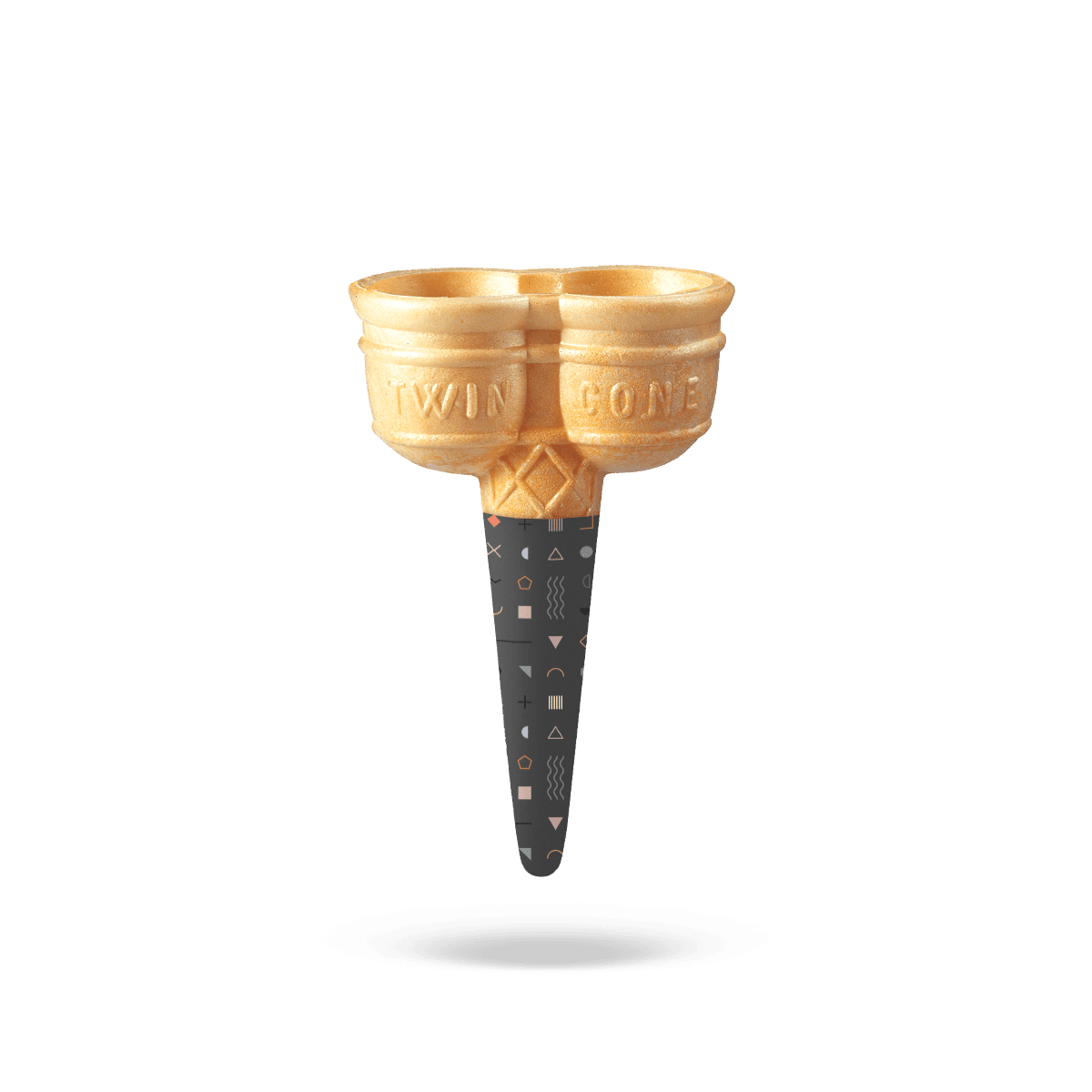
Fit the shared lower body of a double wafer cone instead of sizing from its full two-cup width, so the sleeve grips cleanly without hiding the twin serving.

Measure the Shared Base

A twin cone has a much larger top span than a standard ice cream cone because it carries two side-by-side serving pockets. That does not mean the sleeve should be sized from the full width across both upper cups.

The working sleeve normally sits lower, around the shared body of the edible cone.

That is the first decision for Custom Twin Cone Sleeves: measure the part the paper actually wraps, not the most visually obvious dimension at the top.

Twin or double wafer cones are molded specifically to hold two servings side by side, then join into one lower body. The sleeve belongs around that common lower geometry.

A sleeve drawn from the total twin width can become unnecessarily broad, ride too high or cover the point where the two upper forms meet. A sleeve drawn around the shared lower body can create a much cleaner grip.

The custom cone sleeve still follows the physical holding zone. Twin geometry simply makes the correct measuring point easier to misunderstand.

Ignore the Widest Span

Do not use the outside-to-outside width of the two upper cups as the primary sleeve measurement.

That dimension matters to the food presentation, but it may have little relationship to the circumference lower down where the hand holds the cone.

Measure the common body at the intended sleeve height.

That gives the dieline a real structural reference instead of forcing a paper wrap around a dimension it will never touch.

Record Both Heights

Twin cones can change shape quickly between the shared lower body and the two upper serving areas.

Record the full cone height and the height where the two-cup geometry begins.

The sleeve should generally stop before it interferes with that transition unless a deliberately taller structure has been developed around the specific cone.


The Split Must Stay Clear

The defining visual feature of a twin cone is the separation between the two serving sides.

Covering too much of that area weakens the point of using the cone.

Customers should be able to see that the serving has two distinct upper positions, especially when the shop uses different flavors or toppings on each side.

The sleeve should support the shared grip while letting the twin form remain obvious.

Stop Before the Branch

Think of the upper cone as branching into two serving areas.

A sleeve that climbs into that branch can wrinkle, flare outward or create awkward pressure against the two sides.

Keeping the top edge lower gives the paper a more predictable conical surface to follow.

It also leaves the food presentation visually open.

Flavor Separation Should Read

Twin cones are often chosen because two flavors can be presented together without looking like one ordinary double-scoop serving.

The sleeve can reinforce that distinction with artwork, but it should not visually merge the two sides.

A central graphic, paired color treatment or simple left-right motif can support the concept without pretending the sleeve itself has two independent compartments.

Two Scoops Shift the Balance

A standard cone concentrates its upper load around one centerline.

A twin cone places more of the serving across a larger top span.

That can make the cone feel different in the hand even when the sleeve fits the lower body correctly.

The customer may naturally grip slightly higher or hold the cone more upright to manage the broader serving mass.

The sleeve height should account for that behavior.

Greater Top Span Creates Leverage

Two filled sides create more mass across the top of the hand.

If the sleeve is very short, the customer may grip exposed cone higher up to feel more secure. If the sleeve is excessively tall, it may approach the twin transition and interfere with the edible structure.

The strongest coverage sits between those two problems.

Test the cone fully filled rather than approving hand position from an empty wafer.

Uneven Flavors Can Tilt

Two sides will not always weigh exactly the same.

One scoop may be larger. One topping may be heavier. Soft serve may settle differently between the two positions.

The sleeve cannot eliminate that imbalance, but it can give the hand a stable central grip so small differences do not make the entire serving difficult to control.

The customer should not need to pinch one side of the cone to compensate.

Grip Belongs on the Centerline

Because the serving visually splits at the top, artwork can tempt designers to divide the sleeve into two equal graphic halves.

The hand does not necessarily behave that way.

The grip still centers around the shared lower cone.

That central holding zone deserves enough uninterrupted material to remain comfortable and structurally stable.

Avoid a Weak Middle

Do not create a deep notch, oversized cutout or narrow paper bridge directly through the central grip merely to echo the twin shape.

The twin effect already comes from the edible cone.

Removing structural material from the sleeve can make the lower wrap feel less stable without adding much visual value.

If a distinctive outline is genuinely important, Die-Cut Cone Sleeves put cut geometry and remaining paper strength at the center of the specification.

Seam Position Still Matters

The overlap should sit where it does not create an uncomfortable ridge under the strongest finger pressure.

That can require a slightly different orientation from a standard sleeve if the twin cone has a natural front face.

Form the sleeve, fill both sides and observe how people actually pick it up.

One Sleeve, Two Flavors

Twin cones create an unusually strong opportunity for paired artwork.

The packaging can visually acknowledge two flavors without turning the sleeve into two separate designs.

A left-right color split, paired icon system or two short flavor cues can make the concept immediately clear.

The visual system should still work when both sides contain the same flavor.

Split Color Deliberately

A two-color design can echo the two upper servings.

The split does not need to fall exactly under the physical division between the cone cups. On a curved tapered wrap, forcing perfect visual alignment may create unnecessary production sensitivity.

Instead, create a clear paired composition that still looks intentional when the sleeve is viewed from a normal handoff angle.

Keep the Logo Unified

The brand should not be divided into two weak halves simply because the serving contains two flavors.

Keep one strong brand mark.

Let secondary artwork communicate the pairing.

For branding-led programs with several flavor combinations, Custom Printed Cone Sleeves focus on curved artwork placement, seam clearance and version control.

Pairings Can Multiply SKUs

Twin cones can create more artwork combinations than expected.

Suppose a shop regularly sells vanilla/chocolate, vanilla/strawberry and chocolate/strawberry. Printing a dedicated sleeve for every possible pairing may create unnecessary inventory.

The packaging system should decide whether the sleeve identifies the exact combination or simply celebrates the twin-serving concept.

That decision affects artwork count, reorder complexity and how much stock each location has to hold.

Generic Twin Art Simplifies Stock

One permanent twin-cone sleeve can work across many flavor combinations.

The food itself communicates the actual flavors.

This approach reduces artwork versions and makes it easier for staff to use whatever pairing the customer orders.

It can also reduce leftover printed stock when menu combinations change.

Fixed Pairings Can Earn Codes

A permanent signature pairing may justify its own sleeve treatment.

The distinction could be a color band, short flavor name or small icon rather than an entirely separate design system.

Use separate artwork when it helps staff or customers identify something important, not merely because two colors are possible.

Twin Is Not Double Scoop

A twin cone and a standard cone carrying two scoops are not automatically the same packaging problem.

A conventional waffle or sugar cone can hold more than one scoop while keeping one ordinary conical body.

A true twin wafer cone has a different upper geometry created specifically for side-by-side serving.

The sleeve should follow the physical cone, not the menu phrase.

Standard Cones Stay Standard

If the shop simply places two scoops on one ordinary waffle cone, the sleeve normally still follows that ordinary cone profile.

Waffle Cone Sleeves make more sense when the edible cone remains a conventional waffle shape.

Calling the serving “double scoop” does not create twin-cone geometry.

Twin Molds Need Measurements

If the cone has two molded upper cups, measure that exact product.

Commercial twin cones vary in dimensions and proportions between suppliers.

Do not copy a sleeve made for another manufacturer’s twin cone because the menu name happens to match.

Counter Setup Needs More Room

Twin cones can occupy more lateral space at the top than standard single cones.

That affects how staff stage empty cones, fill them and move completed servings across a counter.

The sleeve should not introduce more width or flare than the edible cone already requires.

Ice cream shops often coordinate cones with cups, napkins, boxes and other food-service packaging, so Food, Bakery & Restaurants packaging should account for the twin cone’s counter footprint.

Filling Uses Two Positions

Staff need clear access to both serving sides.

A sleeve that reaches too high can obstruct the lower edge of one or both cups, especially if the paper is stiff or the twin body flares suddenly.

Fill several cones at normal speed.

Watch whether the sleeve affects scooping, soft-serve placement or topping application.

Finished Cones Need Clearance

Two completed twin cones placed next to each other require more counter width than ordinary single servings.

If several are prepared simultaneously, the work area can become crowded quickly.

Packaging should help organize the serving, not make that footprint larger without a reason.

Material Supports the Shared Grip

The sleeve material does not need to support two cones independently.

Its main structural job remains at the shared grip.

Paper can work where the service is light and straightforward. Firmer paperboard may make sense when a more substantial hand feel is wanted, but excessive stiffness can resist a relatively narrow lower radius.

Cardboard Cone Sleeves address caliper, springback and seam bulk when stock stiffness becomes the primary concern.

Melt Reaches One Sleeve

Two servings can create more exposed melting surface than one smaller scoop, but the material requirement should still be based on actual service conditions.

Test how long customers typically hold the cone and whether melt, toppings or condensation reach the grip.

Do not assume that the word “twin” automatically requires a barrier construction.

Direct Contact Needs Confirmation

If any part of the sleeve is intended to contact food directly, confirm the exact stock, inks, coatings and adhesives for that use.

Material names alone do not establish contact suitability.

The complete production construction needs to match the intended serving.

Events Favor the Shared Handoff

Twin cones can create a visually distinctive serving at weddings, dessert bars, launches and branded events because two flavors appear together in one hand.

That presentation value can justify more deliberate sleeve artwork even when the underlying paper structure remains simple.

For event service, Hospitality packaging should support the twin cone as part of a coordinated guest experience.

Pairing Can Carry a Theme

Two serving positions naturally support paired concepts.

A wedding dessert could use two signature flavors. A brand activation could pair two campaign colors. A seasonal service could combine contrasting toppings.

The sleeve can connect those two sides visually without covering the feature that makes the twin cone distinctive.

Photos Need a Clear Front

A twin cone already creates a larger visual composition than a standard cone.

Place the logo where it remains readable beneath that composition rather than competing with it.

A centered mark or controlled repeating pattern often handles casual rotation better than artwork that only works from one exact angle.

Prototype the Filled Twin

The most meaningful approval is a sleeve on the real twin cone with both sides filled.

An empty cone will not reveal balance, hand position or whether the sleeve sits too close to the double upper structure.

Use several actual cones because wafer dimensions can vary.

Then test:

  • where the sleeve stops
  • whether either upper side is obstructed
  • where the hand naturally closes
  • how the serving feels with two different loads
  • whether the sleeve rotates
  • whether the seam becomes uncomfortable
  • whether artwork remains readable
  • whether staff can fill both sides cleanly

Free 3D mockups and digital proofing can help assess artwork and geometry before production. A physical sample becomes more valuable when the exact twin-cone fit or unusual structure needs to be proven.

Specify the Cone, Not Twin

The strongest production handoff identifies the actual edible cone.

Send the manufacturer or cone reference if known, plus:

  • full cone height
  • maximum upper span
  • shared lower-body diameter or circumference at sleeve height
  • point where the twin upper form begins
  • preferred sleeve height
  • material direction
  • print artwork
  • quantity
  • number of printed versions
  • intended serving method

The cone sleeve sizing process reinforces the same principle: dimensions from the real serving object give a stronger production basis than generic size names.

Custom Packly can then develop the dieline around the measured lower body, review artwork and prepare the approved production specification.

The Sleeve Should Unify Two Sides

Twin cone packaging works when the paper does less than the edible cone.

The cone already creates the two serving positions.

The sleeve should not recreate that complexity unnecessarily.

Its job is to give the shared lower body a clean grip, preserve the twin silhouette and create one branded surface beneath two flavors.

That leads to a simple decision rule.

If the structure contains two molded upper serving positions joining into one lower cone, develop the sleeve around that shared lower geometry.

If it is simply one ordinary cone carrying two scoops, use the sleeve specification for that ordinary cone.

Custom Twin Cone Sleeves become genuinely distinct when they solve the fit and presentation of the double wafer shape rather than using “twin” as another name for a larger ice cream serving.

FAQs

Twin Cone Sleeves are for a molded double or twin wafer cone with two upper serving positions joining into one lower body. The sleeve is fitted around that shared base rather than treating the serving as two separate cones.

Measure the circumference where the sleeve actually sits, not the full span across the two upper cups. That keeps the grip centered and prevents the sleeve from riding into the twin transition.

Choose Twin Cone Sleeves for a physically molded double wafer cone. Child-Size Cone Sleeves are for a smaller single cone that needs reduced taper, coverage and grip dimensions.

Not necessarily. One strong logo can stay unified on the shared lower sleeve while color, icons or secondary graphics echo the two flavors or serving positions above.

No. If two scoops sit on one conventional waffle or sugar cone, the sleeve should follow that ordinary cone profile. Twin Cone Sleeves are for the physically different double or twin wafer structure.

Process

How it works

Your Packaging Journey, From Idea to Production and Delivery

01

Tell Us Your Specs

Custom packaging boxes

Tell Us Your Specs

Provide size, quantity, printing, and finishes.

02

Get a Fast Quote

Custom packaging boxes

Get a Fast Quote

Instant transparent pricing, no hidden fees.

03

Design and Approval

Custom packaging boxes

Design and Approval

Artwork checks, revisions, and final sign-off.

04

Produce

Custom packaging boxes

Produce

Expert manufacturing to meet deadlines.

05

Ship to Your Door

Custom packaging boxes

Ship to Your Door

Hassle-free, flexible delivery options.

Get Your Quote for Custom Twin Cone Sleeves

Share your product details, size, quantity and artwork needs. We’ll help choose the right packaging style and send a clear quote.


