Black Friday Packaging Starts Before Your First Sale
A Black Friday packaging checklist should answer five questions before orders arrive: Do you have enough of the right boxes? Will they protect products in transit? Is every promotional design approved? Can your fulfillment operation handle the surge? And will customers remember your brand once the discount has passed? These decisions matter whether you ship 100 orders, coordinate thousands of parcels or replenish packaging across multiple retail locations.
Late packaging orders and last-minute artwork changes are two problems we've encountered repeatedly before Black Friday. Either can turn a manageable promotional refresh into a scramble against the receiving deadline.
For a straightforward Black Friday box order, aim to place it two to three weeks before the packaging is needed on site, with the artwork close to approval. Complex structures, specialty finishes or unusual quantities can need more time. Urgent production may be possible, but a sales campaign should not depend on a last-minute rescue.
Seasonal packaging should do two jobs at once. It needs to get the product safely to the customer, then give that customer a reason to remember who sent it.
Count the Orders You Expect, Not Just the Products You Sell
Forecast the Actual Packaging Mix
Start with last year's orders, current sales pace, planned discounts and the products you expect to promote. Forecast how items will be ordered together, not simply how many individual units you hope to sell. For established retailers and high-volume ecommerce operations, separate demand by sales channel, warehouse, store and packaging specification so one location does not run out while another holds surplus stock.
A shopper buying one skincare product may need a different box from someone buying a three-piece gift set. An apparel store may ship individual garments in a compact mailer but need a larger format for bundles. Count by likely packed order rather than individual SKU.

Before placing a seasonal order, record:
Avoid treating a forecast as certainty. A reliable forecast may support a new printed run. An uncertain forecast is a reason to keep seasonal commitments flexible.
For a brand balancing single-item shipments and promotional bundles, ecommerce packaging should be planned around the finished order and fulfillment process, not just a product photograph.
Keep the Structure if Only the Message Needs to Change
Ask what genuinely needs to change for the event. If your existing box fits well, protects the product and packs efficiently, there may be no reason to replace its structure.
A Black Friday promotion might require different exterior artwork, an inside message, a coupon card or a removable sticker. Changing the physical dimensions or closure at the same time introduces new fit checks and production work.
When the product and box still fit each other, there is usually no reason to redesign the structure just to announce a seasonal offer. Keeping the proven construction means there are fewer technical decisions to reopen while the deadline is approaching.
A Real Black Friday Refresh: 5,000 Rigid Boxes and 13,000 Mailers
A US customer came to Custom Packly with packaging already in use and a specific Black Friday request: update the design so the boxes themselves carried promotional and discount messaging. This was an artwork refresh for familiar formats, not a request to develop entirely new structures.
The request covered 5,000 rigid boxes and 13,000 mailer boxes, a combined 18,000 pieces. The customer needed the packaging ahead of the main sales period so the business could prepare for orders on and around Black Friday.
We accelerated production and delivered the order. The lesson is not that every 18,000-piece project can be completed on an identical schedule. It is that this customer already knew which two packaging formats were needed and why the artwork mattered.
Updating a proven design is very different from developing an unfamiliar structure, sourcing specialty materials and approving complex finishes under the same deadline.

The practical lesson is to protect decisions that are already working and concentrate the changes on the promotion. A business using custom rigid boxes and custom mailer boxes can focus on seasonal messaging without rebuilding its entire packaging system.
Choose Between Stickers and Newly Printed Boxes
When Promotional Stickers Are the Smarter Option
If sales volume is hard to predict, stickers can make existing inventory useful for Black Friday. Add a well-designed promotional label to boxes that already fit the product, or consider a sleeve or insert card if the structure permits it.
This approach gives any business flexibility when promotional demand is uncertain. Smaller runs can avoid committing too much budget to a one-off design, while large retailers can refresh packaging already distributed across stores or fulfillment centers. It is especially useful when the base packaging will still be needed after the promotion.
Check that the sticker adheres to the actual surface, stays legible during handling and does not obscure a barcode, opening instruction or required label. If it crosses a closure, test whether it interferes with opening or leaves residue.
When a Fully Printed Seasonal Run Makes Sense
When a business has a reliable forecast, newly printed boxes can be a stronger investment. A coordinated seasonal run can keep graphics, colors and promotions consistent across product lines, order volumes and fulfillment locations, provided the correct artwork version is assigned to each specification.
Some of our seasonal customers have described positive reactions and sales benefits when their packaging feels memorable and intentional. That experience supports investing in unboxing when the forecast justifies it, but it does not establish a predictable sales increase for every business.
Compare the economics of refreshing existing stock with ordering custom printed boxes. Consider quantity, material, print coverage, remaining inventory and whether the new artwork will still be useful after the promotion.
A practical rule is simple: uncertain forecast, use a lighter seasonal upgrade; dependable forecast, consider a coordinated printed run.

Match Every Box to the Product and Fulfillment Method
Mailers for Direct-to-Consumer Orders
Printed corrugated mailers work when a business wants a branded unboxing and a structure suited to the product and shipping route. Their folds and closures still need to be checked against the packed weight and contents.
Black Friday can change the average order. A mailer sized for one product may no longer work when customers buy discounted bundles. Test product movement and closure security with likely promotional combinations.
Rigid Boxes for Gift Sets and Higher-Value Purchases
Rigid boxes can elevate beauty products, jewelry, gift sets and other purchases where presentation is part of the product's value. Use fitted inserts when needed to keep items organized and control the opening experience.
A rigid presentation box is not automatically parcel-ready. Ecommerce shipments may need an outer corrugated mailer or shipping carton to protect decorative surfaces during transit.

Folding Cartons for Lightweight Retail Products
A small consumer product may be better suited to folding cartons than a heavy setup box. Efficient flat storage, printed product information and manageable assembly can matter more than elaborate presentation for a high-volume promotion.
For seasonal multipacks, confirm how the items sit, whether the bottom construction supports their combined weight and how easily the box can be assembled.
Corrugated Shippers for Heavier or Mixed Orders
For heavy products or larger mixed baskets, use corrugated shipping boxes with board strength and internal support suited to real handling conditions. A beautiful box that arrives crushed does not deliver a successful unboxing.
Oversized shippers may require more void fill, allow product movement and affect dimensional shipping charges. The principles behind reducing shipping damage with better box structure and fit remain important when order volume rises.
Lock Artwork Before Production Begins
Verify the Discount Before Approving Print Files
One of the most avoidable production problems is changing promotional wording after a design should already be final. A last-minute adjustment to discount percentages, dates or coupon codes can affect the proof and production schedule.
Before sign-off, confirm:
Do not print a short-lived offer on more packaging than you expect to use while the offer is valid. A reusable seasonal design plus a changeable coupon insert may be a smarter approach.
Inspect the Dieline, Not Just a Digital Mockup
A design can look correct on a screen and fail once the box is folded. A QR code may land too close to an edge, discount text may cross a crease or the logo may end up on a side panel instead of the intended front.
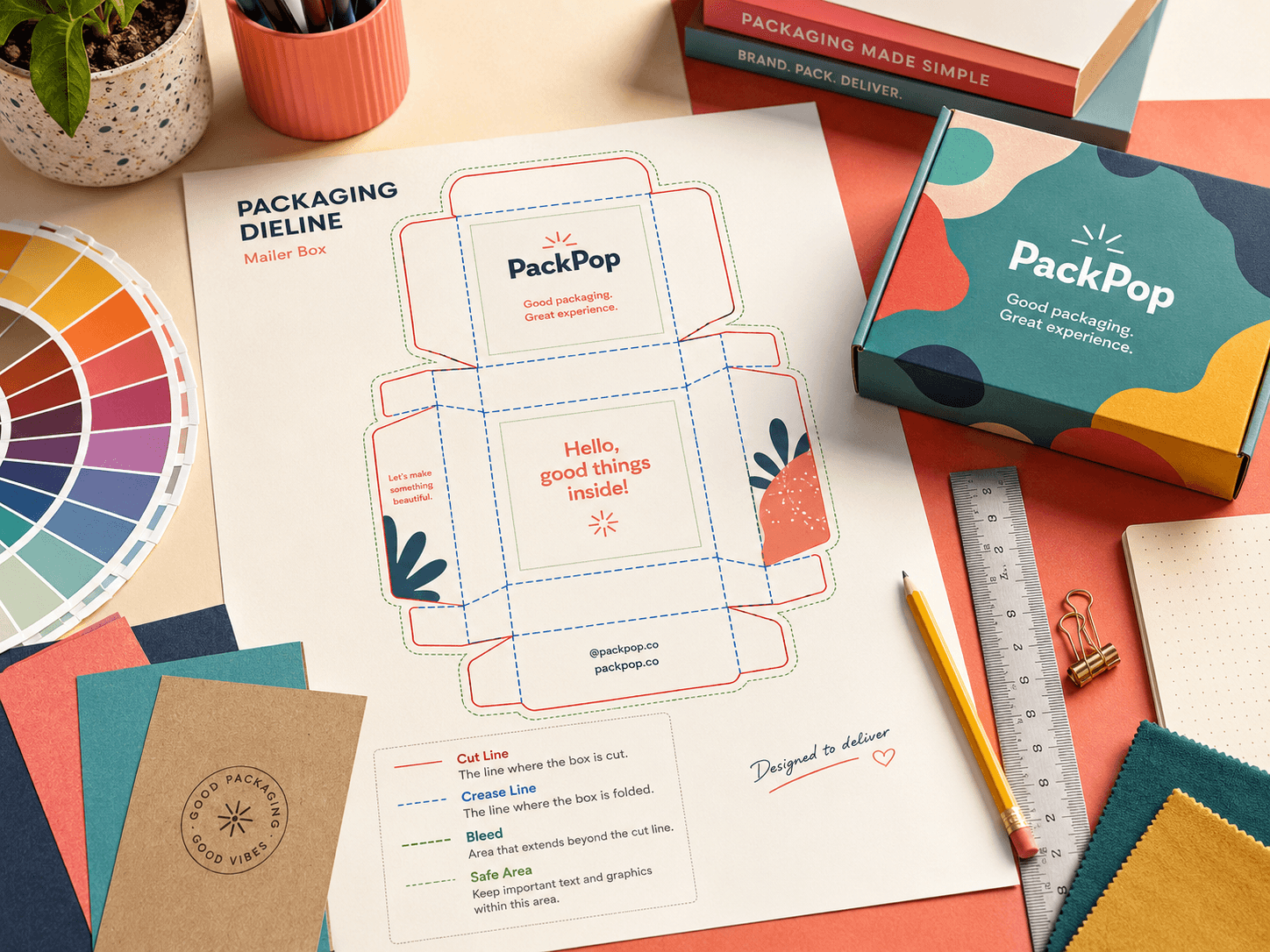
Use the approved layout for the actual structure and dimensions. If you need a starting layout for a supported structure, the dieline generator can help establish panel positions. Keep important text inside safe areas, allow the required bleed and confirm that production marks are not part of the printed artwork.
Review the proof at a realistic size. Print and scan a QR-code test using the intended material and finish. A reflective coating or fold can make a code difficult to scan even when it works on screen.

The thinking behind packaging that builds a stronger brand applies equally to a seasonal promotion: confirm structure and fit first, then artwork and finishing.
Work Backward From the Day You Need Packaging on Site
For a straightforward seasonal box order, two to three weeks before the required arrival date is a sensible planning target. That is not a universal production or shipping guarantee; the actual timeline depends on specification, approval status, volume and destination.
Your deadline is not necessarily the day the sale begins. If your team needs a week to assemble kits, prepare gift sets or distribute stock across multiple stores and fulfillment centers, packaging must arrive earlier. Larger operations should also confirm staggered receiving dates, location-specific quantities and who approves any replenishment changes.
Follow this order of decisions:

Custom Packly's standard US turnaround is generally four to six business days after final specifications and artwork approval for qualifying work. Specialty structures, advanced finishes and particular project conditions can require more time. Shipping delays are also possible, especially in peak season.
Urgent orders can be assessed and accommodated when the specifications and schedule allow, but faster production cannot eliminate every shipping risk. Ordering late and making repeated artwork changes are still the two avoidable mistakes that cause the most pressure before a major promotion.
Make the Unboxing Memorable After the Discount
Someone may discover your brand because of a Black Friday offer. Packaging is an opportunity to show that the brand offers more than a temporary discount.
You do not need premium finishes everywhere. Focus attention on a clean opening, secure product placement, recognizable branding and one useful reason for customers to engage again.
Practical ideas include:
A QR code needs a real purpose. A dead destination, unclear coupon or misleading offer creates frustration rather than engagement. Test it on a phone and make sure the destination remains valid when the parcel reaches the buyer.
Customers are more likely to remember a useful follow-up offer, a satisfying opening experience and a product that arrives safely than decorative extras that add cost without improving the purchase. The goal is a package that feels considered, not overloaded for one weekend.
Before expanding the print specification, consider what custom printed boxes cost at different quantities. The package needs to fit the product's commercial model as well as its visual identity.
Test a Real Packing Shift Before Orders Spike
A box may pass a design review and still slow down a busy packing team. For a single packing station, test the assembly sequence and common bundles. For a high-volume operation, also consider packing-line consistency, labor time, location-specific inventory and whether changing box sizes disrupts the workflow.
Pack a single-item order, a mixed basket and the most delicate gift set using the materials and methods intended for Black Friday. Watch for:

Record which box, insert and artwork version belongs with each order type. Fix problems before the packing line is busy rather than after complaints arrive.
The Final Black Friday Packaging Checklist
Use this before signing off seasonal packaging:
Spend on What Your Customers Will Notice
The strongest Black Friday packaging is not necessarily the most elaborate. It is the packaging that fits the forecast, arrives before the team needs it, carries the correct promotion and protects the product.
For a business testing demand, that may mean stickers and a thoughtful coupon card. For an established retailer or a high-volume ecommerce brand with dependable forecasts, it may mean coordinated fully printed runs, multiple box formats and staged deliveries across locations. The right investment depends on demand, fulfillment requirements and the experience customers should remember.
When the structure, dimensions, quantities and receiving date are taking shape, request a custom packaging quote and include the delivery ZIP code and artwork status. Those details help us discuss printing, production options and a realistic schedule before the rush.