For occasional shipments, a USPS Priority Mail Flat Rate box can be the simplest economical choice. For a small business sending repeat ecommerce orders, a properly sized box with USPS Ground Advantage or regular Priority Mail may cost less. Neither option wins every time. The answer depends on the packed product, its weight and outside dimensions, the destination ZIP code, the service you need and how much you spend to pack each order.
The mistake I see most often is comparing the price of an empty box instead of the full cost of shipping an order. USPS may supply Flat Rate packaging at no charge, but postage is not free. Your own box has a purchase cost, yet the right size may reduce postage, filler or avoidable damage. Compare what happens after the box is filled, sealed and rated by USPS.
What Are You Actually Comparing?
USPS Priority Mail Flat Rate: a set price for an eligible USPS box
USPS Flat Rate means using an official USPS Priority Mail Flat Rate box or envelope and paying the postage assigned to that packaging format. For eligible domestic shipments, the price does not change with the destination or the actual weight up to 70 lb. The contents must fit the issued packaging, and the flaps must close along their normal folds. A box being supplied for free does not make the mailing label free.
This predictability is useful when orders are infrequent, a dense item fits the box comfortably or you ship similar packages to distant ZIP codes. It does not prove that the Flat Rate price is the lowest rate available for that order.
Your own box: choose the box and compare eligible USPS services
With your own corrugated carton or mailer, you can price USPS Ground Advantage or regular weight-and-zone Priority Mail, subject to each service's rules. USPS Ground Advantage requires your own packaging. Regular Priority Mail in your own box is also different from Priority Mail Flat Rate: weight, destination zone and potentially parcel size affect the quote.
For a physical shipper, the starting decision is whether the product needs a conventional corrugated shipping box or a mailer structure. Then compare postage using the sealed parcel's actual dimensions and weight. Use the same purchase channel when comparing retail rates with retail rates or eligible commercial rates with commercial rates. Otherwise, a pricing-channel difference may look like a packaging saving.
When Is USPS Flat Rate Likely to Be Cheaper?
Occasional orders with no reason to hold box inventory
For a business shipping only now and then, I would usually check Flat Rate early. There is no need to buy a production quantity of custom boxes, find storage space or manage a second packaging inventory. If the product fits properly and the quoted postage is competitive, simplicity is worth something. Still, compare an own-box USPS Ground Advantage quote if you already have a suitable carton.
Compact, relatively heavy products
A dense item in a small USPS Flat Rate box may benefit from a postage price that does not increase with the item’s weight, within the service limit. The advantage is often more relevant for shipments going farther away. But heavy products still need enough internal protection, and a Flat Rate box that is too small is not a workaround for correct packing.
A consistent box size shipped to many distant ZIP codes
Flat Rate reduces uncertainty when the same compact item is sent across the country. Ordinary own-box rates vary by zone, so a rate that wins locally might lose on another route. Evaluate your real destination mix rather than choosing based on one nearby customer.
When Can Your Own Box Cost Less?
Lightweight orders that do not need Priority Mail
For lightweight clothing, small accessories and many nonurgent ecommerce orders, USPS Ground Advantage deserves a separate price check. You supply the packaging, but its weight-and-zone price may be lower than buying a Flat Rate Priority Mail label. Do not treat the two services as interchangeable if your buyer needs a different delivery window.

Products that fit poorly in USPS standard sizes
A product may technically fit a Flat Rate box yet leave an awkward pocket of space, require unnecessary cushioning or sit in a risky orientation. For fragile kits and unusual dimensions, the best question is what package protects the product at the lowest defensible total cost. Product-focused custom packaging allows the box, clearance and inserts to be specified around the actual packed item rather than forcing the item into the closest available USPS shape.
Repeat orders with a predictable product mix
When you send the same few products repeatedly, a well-matched own box becomes easier to justify. You can spread its purchasing cost across many shipments, standardize packing and test which package size produces the most economical label for your typical ZIP codes. That is one reason ecommerce fulfillment packaging should be chosen around real order patterns, not just how a box looks on a shelf.
The Size Trap: A Light Parcel Can Be Charged Like a Heavy One
USPS dimensional-weight pricing matters when a domestic Ground Advantage or ordinary Priority Mail parcel exceeds 1 cubic foot, or 1,728 cubic inches. In that situation, the carrier compares actual weight with a dimensional weight calculated from the outside package size. USPS uses length × width × height in inches divided by 139 for this calculation, and the larger billable weight can determine the rate.
The July 2026 USPS Domestic Mail Manual sets out the Ground Advantage dimensional-weight calculation, including service-specific rules for measuring parcels. Check the corresponding Priority Mail rules when selecting that service.
Consider an illustrative 18 × 12 × 10-inch sealed box. Its volume is 2,160 cubic inches, and 2,160 ÷ 139 is about 15.54 lb, rounded up to 16 lb. If the package actually weighs only 3 lb, dimensional weight can drive the postage calculation. This is a dimensional-weight example, not a real USPS shipping quote or a claim about a customer order.
If that same packed product could safely fit in a 12 × 10 × 8-inch box, the volume would be only 960 cubic inches. That is below the 1-cubic-foot dimensional-weight threshold described above. The smaller package is not guaranteed to have lower postage, but it removes one possible source of cost. Do not sacrifice cushioning just to get below a threshold.

Before entering dimensions into a rate calculator, check how outside measurements differ from internal usable space. The physical measurements and common formats in standard US shipping box sizes are a useful starting point. Enter the final sealed exterior dimensions, rounding measurements as USPS requires, not the nominal dimensions of the empty carton.
A Real Ecommerce Customer Reduced Shipping Costs by Changing Box Size
An ecommerce customer we worked with reduced shipping costs after moving to custom-sized boxes. That is the verified outcome; we do not have a documented dollar amount or percentage to attach to it, and I would not turn one result into a promise for every brand.
The lesson from this experience is that box specification deserves the same attention as the postage label. When assessing an order at Custom Packly, we want to know the product's packed footprint, protection requirements, order frequency and destination mix before deciding what size should be made. A custom box cannot lower shipping costs merely by being custom. It helps when its dimensions and structure improve the way the actual parcel is rated and handled.
The Cost Calculation Most Small Businesses Miss
The cheapest box on a supplier invoice is not necessarily the cheapest order to fulfill. Compare the full expense of producing a package ready to arrive safely, rather than isolating the price of cardboard.

The practical break-even question is simple: does the postage and packing expense saved with your own box exceed its additional purchase and handling cost? If not, the free USPS box may be the stronger commercial choice. A beautiful printed exterior is an optional branding decision, not a substitute for this calculation.
How to Run a Fair USPS Shipping Comparison
A quick test on representative orders is more reliable than a general statement that one service is always cheaper. Use your own shipping software or the current USPS calculator and keep the comparison conditions clear.

USPS prices are updated periodically, and temporary holiday-season changes can alter which option wins. Recheck live rates before making a buying decision rather than relying on an old Flat Rate price screenshot.
For the actual postage comparison, use the current USPS Priority Mail and Flat Rate eligibility rules and obtain a current rate for the finished parcel.
Shipping 100–500 Orders a Month? Test Bulk Packaging Without Overbuying
For a growing ecommerce business shipping roughly 100–500 orders per month, my recommendation is to compare USPS rates first, then request box prices at quantities that match actual demand. Bulk ordering can reduce the price per box, but it also commits cash and storage space. Do not manufacture one oversized box simply to use it for every product.
Start with the shipment mix. One well-fitting size may serve most orders, while a second size handles heavier or larger combinations. If product heights vary, multi-depth shipping boxes may be worth evaluating, but their cut-down positions still have to be measured and rated as shipped. Three sizes are not automatically better than two; each extra size adds inventory and packing decisions.

Pricing bulk custom box orders is most meaningful once you have estimated monthly usage per size, confirmed the board needed to protect the product and allowed for the real storage space. Custom Packly's US minimum order quantity starts at 100 boxes, but the economical production quantity depends on the specifications and demand rather than that minimum alone.
Protection and Branding Should Change the Decision Only When They Matter
An own-box option can improve the unboxing experience when printed exterior branding, a deliberate opening style or a tidy interior has value to the customer. Some brands use custom mailer boxes to combine shipping protection and presentation in a single structure. Others use a plain outer shipper and keep the branded product carton inside. USPS Flat Rate can also carry an appropriately sized branded inner box, provided the official Flat Rate outer packaging closes normally.

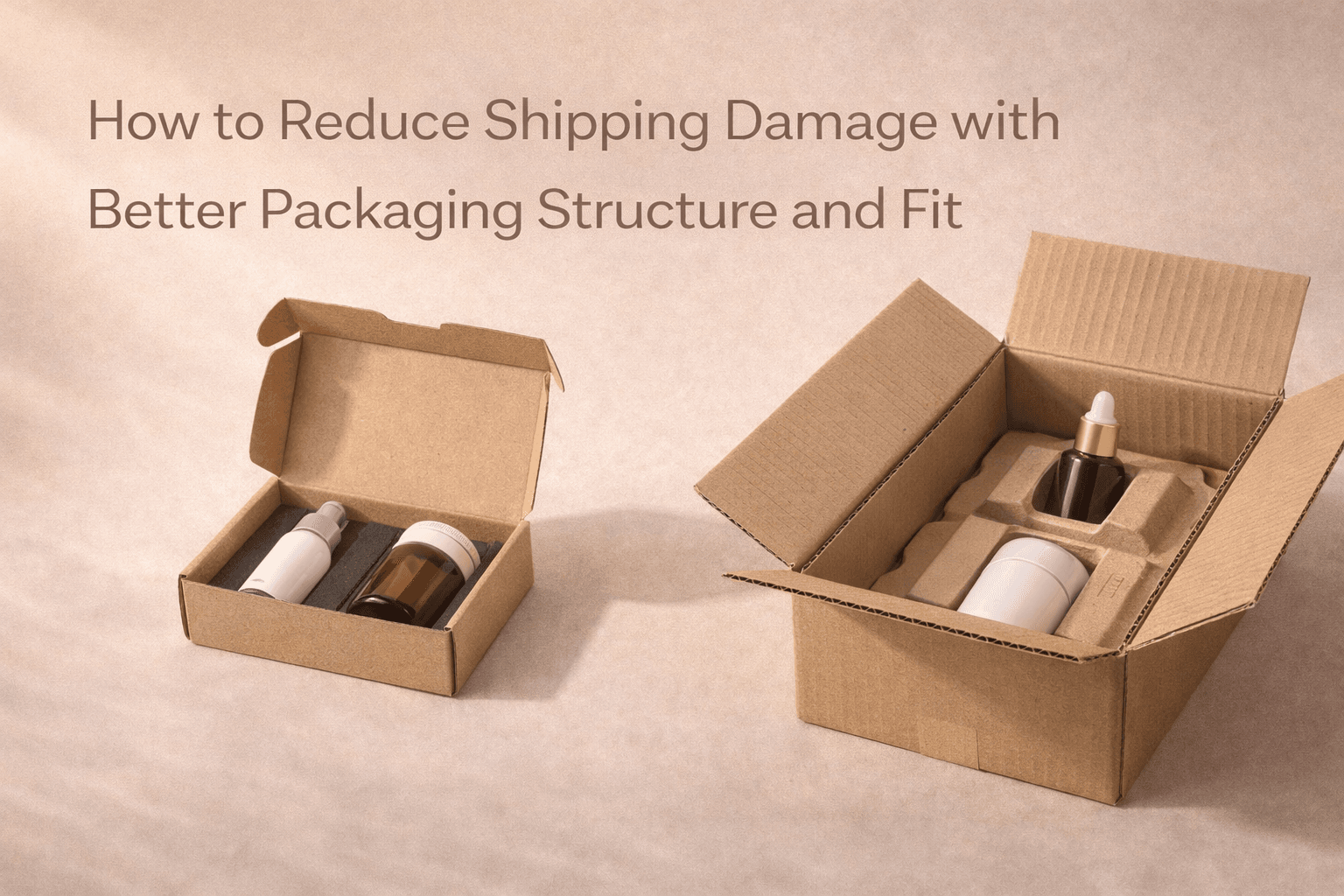
Protection is not simply a matter of buying the thickest board. Match flute, wall strength, product orientation and cushioning to actual handling risks. If you're deciding how tightly an item should sit in a mailer, start with how to choose a mailer box size; if products arrive damaged, consider shipping-box structure and product fit before chasing a smaller label price.
A cheaper postage label is a false economy if the product is crushed or arrives broken. Conversely, unnecessary void fill and an excessively large carton should not be treated as extra protection.
The Practical Verdict
Choose USPS Flat Rate when shipments are occasional, a suitable official box fits well, predictable postage is useful and a current rate comparison supports it. It can also be competitive for compact, heavier items going to distant destinations.
Choose your own box when the product benefits from a tighter fit, you can use a more economical eligible USPS service, or repeat order volume makes the per-box cost reasonable. Review custom-sized boxes against your actual product mix rather than making size or print decisions in isolation.
Before ordering a full run, get real label quotes for your main ZIP codes and test a packed sample. Then request a custom packaging quote using the final dimensions, quantities, material needs and whether printing or inserts are required. The winning option is the one that delivers the product safely at the lowest realistic total cost, not the one with the cheapest empty box.