Digital vs Offset vs Flexographic Printing: The Short Answer
Digital printing is usually the first process I would consider when quantities are lower, artwork changes often or one order contains several designs.
Offset printing becomes more attractive when the artwork is stable, the packaging uses print-friendly paperboard or wraps and the same specification will run repeatedly at meaningful volume.
Flexographic printing is often the practical choice for recurring corrugated, flexible packaging and other production where speed, substrate compatibility and repeat efficiency matter.
But there is no universal quantity where digital suddenly becomes wrong and offset or flexo becomes right.
At Custom Packly, I would not choose a printing method from quantity alone.
I would first look at:
That produces a much better decision than saying, for example, “under 1,000 boxes should always be digital.”
Quantity Is Only One Part of the Printing Decision
Two companies can each order 10,000 boxes and still need different printing methods.
Imagine the first company orders:
The second company orders:
Those are completely different print jobs.
The total quantity is identical, but the second job contains far more artwork variation.
That is why one of the first questions I would ask is not simply:
“How many boxes do you need?”
It is:
“How many boxes do you need per design?”
That distinction can change the economics of the entire job.

Use These Five Factors Before Choosing a Printing Process
1. Start With the Material
The print process has to suit the surface.
Smooth paperboard gives you a different printing condition from brown corrugated board. A wrapped rigid box creates another production route. Flexible film behaves differently again.
For example, Folding Cartons give printers a smooth paperboard surface suited to detailed retail graphics.
Shipping Boxes usually place more emphasis on corrugated strength, transit performance and efficient branding.
Flexible Pouches introduce films, barrier structures, sealing areas and other production considerations that do not exist on a folding carton.
Material comes first because a print method that performs beautifully on one substrate may be unnecessary, impractical or inefficient on another.
If you are still deciding between corrugated, paperboard, kraft and rigid board, compare how those packaging materials behave before locking the printing process.
2. Count Artwork Versions, Not Just Boxes
A 20,000-piece single-design run is one thing.
Twenty designs at 1,000 pieces each are another.
Every version can affect:
This is one of digital printing's strongest advantages.
Changing the artwork does not require the same conventional plate workflow for every version.
That can make digital especially useful for:
The more unstable the artwork is, the more I value flexibility.
3. Decide What the Artwork Actually Demands
Do not pay for printing complexity your design does not use.
A corrugated box carrying one logo, a recycling mark and a short line of copy has a different job from a cosmetics carton carrying gradients, fine type and detailed illustrations.
Likewise, a premium box that relies mostly on one restrained brand color and foil may not need the same production approach as a full photographic design.
For packaging where the artwork itself is the main selling surface, Custom Printed Boxes need the print method, substrate and artwork planned together.
Also separate the printing-process decision from the color-system decision.
Digital vs offset vs flexographic printing asks:
How will the image be put onto the material?
CMYK vs Pantone asks:
How will the colors be produced or controlled?
If exact brand shades are part of the problem, the decision between CMYK and Pantone should be made alongside the press choice.
4. Include the Finish Before You Choose the Press
Printing does not happen in isolation.
The package may still need:
I prefer to know those requirements before approving the print setup.
A print method that looks attractive by itself may become less practical once the complete production sequence is considered.
This matters especially for Custom Rigid Boxes, where printed wraps, specialty papers, foil, embossing and other surface treatments can carry as much visual weight as the ink itself.
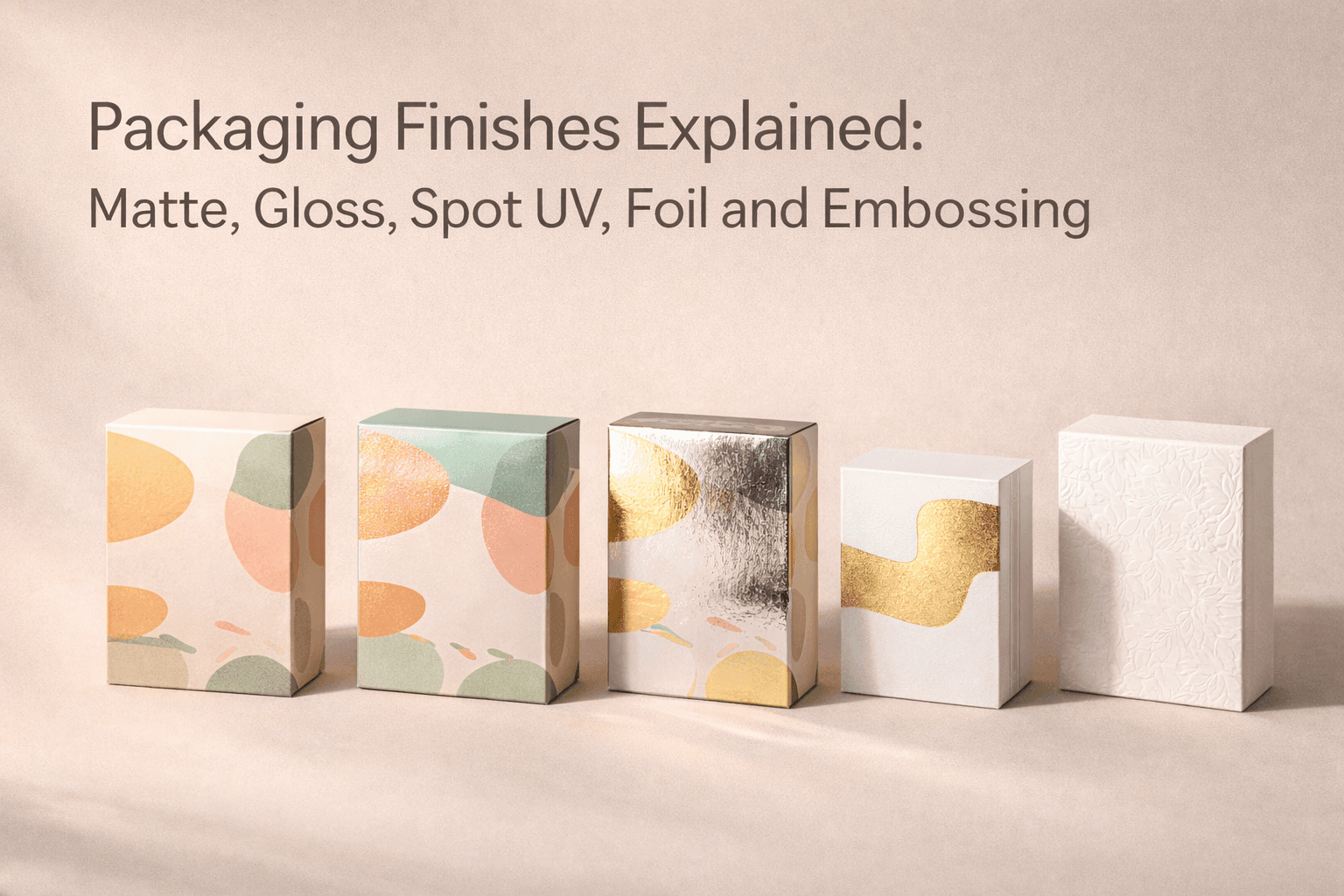
You can also see how matte, gloss, Spot UV, foil and embossing interact differently with the printed surface.
5. Think About the Next Order
The first run can distort the decision.
A brand launching a new product may value flexibility more than the lowest possible long-run unit cost.
Six months later, one design may be selling consistently enough to justify a different production route.
That is normal.
I do not think brands should become emotionally attached to one printing method.
The correct method can change as:
Sometimes digital is the right way to launch and offset becomes the better way to scale.
Sometimes a corrugated program starts small and later moves toward efficient recurring flexographic production.
The printing method should follow the business situation.
When Digital Printing Is the Better Choice
Digital printing works without conventional printing plates for each design.
That changes the setup economics and makes artwork changes much easier.
I would look seriously at digital when the job involves:
Digital Printing Gives You Flexibility Before You Have Certainty
This is where I think digital printing earns its place.
Imagine a new food company launching six flavors.
The company does not yet know whether Flavor A will outsell Flavor F by ten to one.
Producing a huge quantity of every design simply to chase a lower box price can create dead packaging inventory.
Digital production can allow the business to stay closer to actual demand while it learns what sells.
That benefit is easy to miss when a buyer compares only the price per box.

Digital Does Not Automatically Mean Lower Quality
I would also avoid the old assumption that digital printing is inherently the low-quality option.
Modern packaging presses can produce very strong results.
The useful question is not:
“Is digital good quality?”
Ask:
“Digital printing” by itself is not a complete production specification.
Where Digital Can Lose Its Advantage
Digital becomes less compelling when:
At that point, flexibility may no longer be the thing you are paying for.
When Offset Printing Is the Better Choice
Offset printing uses printing plates and transfers the image to a rubber blanket before it reaches the printed sheet.
That setup takes work.
But fixed setup is not automatically bad.
It becomes easier to justify when a stable design runs over and over again.
I would put offset high on the list when:
Offset Rewards Stability
Suppose you spend money preparing a job and then run only 200 cartons.
That setup is being carried by very few units.
Now imagine the same artwork produces 30,000 cartons and returns several times per year.
The economics change.
The setup becomes a much smaller part of each finished piece.
That is one reason offset can fit mature packaging programs very well.
Offset and Corrugated Are Not Always Direct Printing
There is another distinction worth understanding.
Detailed offset graphics on corrugated packaging may be printed onto a separate liner and laminated to corrugated board.
That can create a cleaner graphic surface than trying to reproduce the same artwork directly onto a rougher corrugated sheet.
So when someone says a corrugated box is “offset printed,” ask how the structure is actually being produced.
The answer may affect:

When Flexographic Printing Is the Better Choice
Flexographic printing uses flexible relief plates and an anilox system to control ink transfer.
It is widely suited to packaging production where efficient repeat printing matters.
I would consider flexo strongly for:
Flexo Is Better Than Its Old Reputation
Some buyers still hear “flexo” and imagine rough one-color printing on a brown shipping carton.
That is too simplistic.
Modern flexographic production can handle far more sophisticated graphics.
The real question is whether the artwork, plate system, ink, anilox specification, substrate and press are suitable for the required result.
A simple direct print on brown corrugated and a high-quality flexographic image on coated film are both called flexo.
They are not the same print job.
Corrugated Board Makes Surface Quality Important
Corrugated board can be rougher and more absorbent than coated paperboard.
That affects:
This does not make flexo a bad choice.
It means the design should respect the surface it is printed on.
For many transit packages, strong typography, a clear logo and controlled color can work better than forcing unnecessary photographic complexity onto the outer shipper.

Fictional Case Study: Six Skincare SKUs, One Launch
This is a fictional scenario built around a common production decision.
A skincare company is launching six serums.
Every carton uses the same dimensions.
But each SKU has:
Initial quantity:
750 cartons per SKU.
Total:
4,500 cartons.
At first glance, someone might say 4,500 cartons sounds large enough to move away from digital.
I would not make that decision yet.
The important number is 750 per design, not 4,500 total.
The company also expects packaging claims and instructions to change after the first production cycle.
For the launch, I would investigate digital first.
Why?
Because the company is still buying information.
It is learning:
Locking every variant into unnecessary conventional setup too early could create more cost rather than less.
If two products later grow to 20,000 cartons per run and the artwork settles, I would price those products again rather than assume digital should remain permanent.
Fictional Case Study: One Supplement Carton, Repeated All Year
Now take a supplement company ordering one folding carton.
The specification is:
This situation is almost the opposite of the skincare launch.
The company values consistency and repeated production more than artwork flexibility.
Offset would be one of the first methods I would price and test.
The setup now supports a stable program rather than an experiment.
The company is not paying for the ability to change twelve designs every month because it does not need that ability.
That is why the same printing advice should not be given to both businesses.
Fictional Case Study: 50,000 Corrugated E-Commerce Boxes
A home-goods company ships 50,000 orders each month.
Its corrugated box uses:
The company asks for the “highest-quality printing available.”
I would first ask why.
This package's main job is shipping.
The artwork is simple.
The order repeats.
The design barely changes.
Flexographic printing deserves serious consideration because the required graphics and production pattern suit it.
Spending more on graphic complexity the customer barely notices would not automatically make the package better.
For smaller direct-to-consumer orders where the box itself plays a larger role in the opening experience, Custom Mailer Boxes may lead to a different print decision.
The key is not to buy the most impressive-sounding printing technology.
Buy the printing the package actually needs.

The Biggest Printing Mistakes I See Buyers Make
Choosing From Quantity Alone
Quantity matters.
It is not the whole decision.
Artwork versions, material, colors, finishing and reorders can all move the crossover point.
Assuming Digital Means Cheap and Offset Means Premium
That is an outdated shortcut.
Either process can be the right or wrong choice.
Production fit matters more than the label.
Treating Flexo as a Low-Quality Process
Modern flexo can produce sophisticated packaging graphics.
The required quality needs to be matched to the substrate and production system.
Ignoring Artwork Version Count
Ten thousand boxes carrying one design and ten thousand boxes divided across ten designs should not automatically receive the same print recommendation.
Approving Color From a Screen
Your monitor is emitting light.
Packaging is reflecting light from printed ink on a physical material.
The two will never be identical production conditions.
Choosing Printing Before Material
This reverses the process.
Pick the structure and substrate first.
Then choose the best way to print it.
Buying a Huge Run Just to Lower the Unit Price
A cheaper unused box is still wasted money.
If ingredients, claims, addresses, barcodes or branding may change, excess packaging can become obsolete inventory.
A Digital Proof and a Production Print Are Not Always the Same Thing
This deserves special attention.
A digitally produced sample can be extremely useful for checking:
But if final production will use another printing method, do not automatically assume the sample represents an exact production color match.
The final result can be affected by:
When color matters, define exactly what is being approved.
Are you approving:
“Sample approved” is too vague for a color-critical job.

Do Not Ask Only for the Price Per Box
When comparing printing methods, compare the whole production decision.
Ask about:
Imagine Method A saves three cents per carton.
That sounds attractive.
But the brand has to buy 30,000 extra cartons to achieve the price, and six months later a required label statement changes.
Those three cents were never really savings.

Which Method Fits Each Buying Situation?
Choose digital printing first when:
Choose offset printing first when:
Choose flexographic printing first when:
“First” matters in every one of those recommendations.
It means that is where I would begin the production comparison.
It does not mean the alternatives should automatically be rejected.
What Information Should You Send Before Asking Which Printing Method Is Best?
For a useful recommendation, send more than an order quantity.
Include:
Those details make the print decision much easier.
They also prevent suppliers from comparing completely different production methods under prices that appear similar.
Which Is Actually Best: Digital, Offset or Flexographic Printing?
There is no single best printing method for custom packaging.
Digital is strongest when flexibility matters.
Offset is strongest when stable, detailed paperboard production justifies its setup.
Flexographic printing is strongest when the substrate and recurring production program suit efficient plate-based printing, especially corrugated and flexible packaging.
My strongest advice is to stop asking which method is “best quality.”
Ask instead:
Which method gives this exact package the quality it needs at the lowest sensible total production cost?
That question includes more than printing.
It includes material, artwork versions, setup, color, finishing, future reorders and the risk of buying packaging you may never use.
The best printing method is the one that still makes sense after all of those factors are included.